MEXICO CITY — When South Korean President Lee Jae-myung stepped onto the tarmac at Felipe Ángeles International Airport alongside First Lady Kim Hea-kyung on the evening of September 23, the transpacific air carried far more than ceremonial pomp. Welcomed by Mexican Foreign Ministry dignitaries and greeted with full diplomatic honors, Lee marked the first state visit by a South Korean head of state to Mexico in sixteen long years.
On the surface, the bilateral summit held at the historic National Palace—preceded by a solemn wreath-laying ceremony at the Altar to the Nation in Chapultepec Park—featured all the grand trimmings of a milestone diplomatic reunion. Yet behind the palace doors, the talks between President Lee and Mexican President Claudia Sheinbaum were driven by hard-nosed economic arithmetic: an urgent mutual appetite to secure vital energy supplies, fortify global supply chains, and re-engineer industrial ties in an increasingly volatile global order.
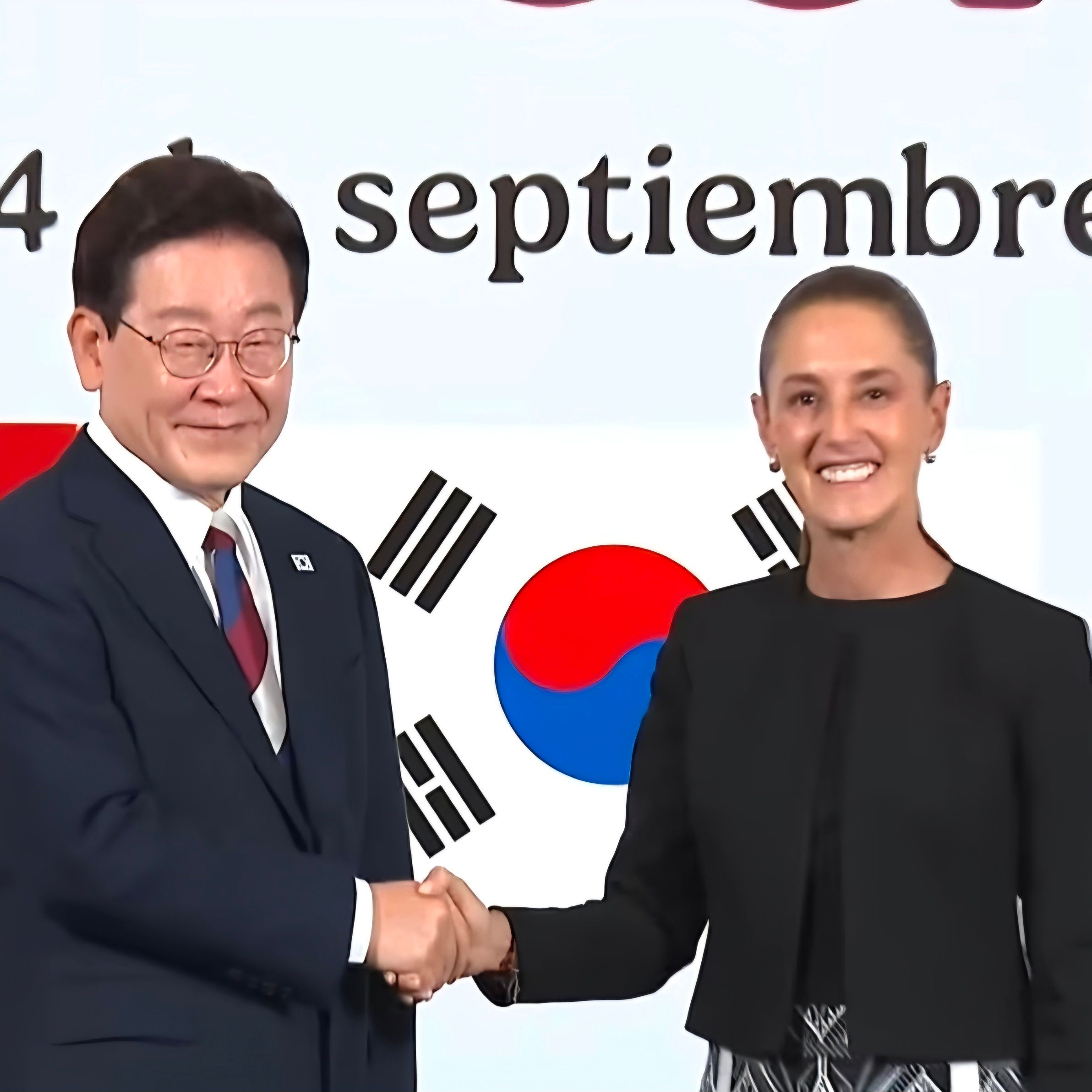
At the heart of the summit’s breakthrough announcements was a newly minted, inter-ministerial dialogue channel specifically designed to coordinate policies on crude oil and critical natural resources. Energy security took center stage early in the proceedings, with Lee publicly expressing profound gratitude to Sheinbaum for Mexico’s critical intervention following their May telephone dialogue, which enabled additional crude shipments to Korean conglomerates amid turbulent international markets. By turning an ad-hoc lifeline into a institutionalized ministerial pipeline, Seoul secured a more reliable gateway to Latin America’s natural abundance, while Mexico anchored a top-tier industrial buyer for its energy reserves.
The economic convergence did not stop at raw barrels. Addressing the broader trade framework, Lee pressed for the swift conclusion of a bilateral Free Trade Agreement, emphasizing that a predictable, formalized commercial environment remains imperative for cross-border investment. The diplomatic push bore immediate fruit with the formal conclusion of the Bilateral Investment Treaty revision talks—a stubborn, seven-year negotiation finally resolved in Mexico City, with both governments pledging swift domestic ratification.
Looking beyond traditional commerce, the summit revealed an ambitious blueprint spanning high-tech manufacturing, defense, and outer space. Seoul announced plans to dispatch a high-level public-private trade delegation to Mexico this November to accelerate digital transformation. That same month, the inaugural "Korea-Mexico Space Day" will convene to incubate joint ventures in aerospace technology.
Perhaps the most geopolitical pivot surfaced in defense cooperation. As Mexico pursues military modernization, Korea pitched its formidable "K-Defense" hardware not merely for direct export, but as a joint manufacturing enterprise on Mexican soil aimed at penetrating third-party markets across the Americas. Paired with plans to establish a bilateral working group for joint cultural content production and expanded K-culture hubs across Mexico, the transpacific partnership demonstrated that after a 16-year pause, Seoul and Mexico City are no longer just distant trading partners, but intertwined strategic allies.
TAP HERE for an English-Korean bilingual version. [영한대역으로 보려면 여기를 누르세요]