SEOUL — South Korean President Lee Jae-myung unveiled a sweeping mid-term cabinet reshuffle on Sunday, replacing six ministerial posts and realigning his core presidential staff to regain political momentum against headwinds of controversial property taxes, stock market dips, and dipping public approval ratings.
The reshuffle, described by the presidential office as an initiative to "tighten shoelaces and run hard once again," reflects a dual-track strategy. The administration promoted seasoned technocrats to lead economic and housing sectors to ensure policy continuity and speed, while enlisting high-profile politicians across the broader progressive spectrum to steer legal reforms and parliamentary negotiations.
Internal Promotions to Speed Up Economic and Housing Delivery
To restore market confidence and fast-track policy execution, the president turned to seasoned administrative insiders rather than external figures.
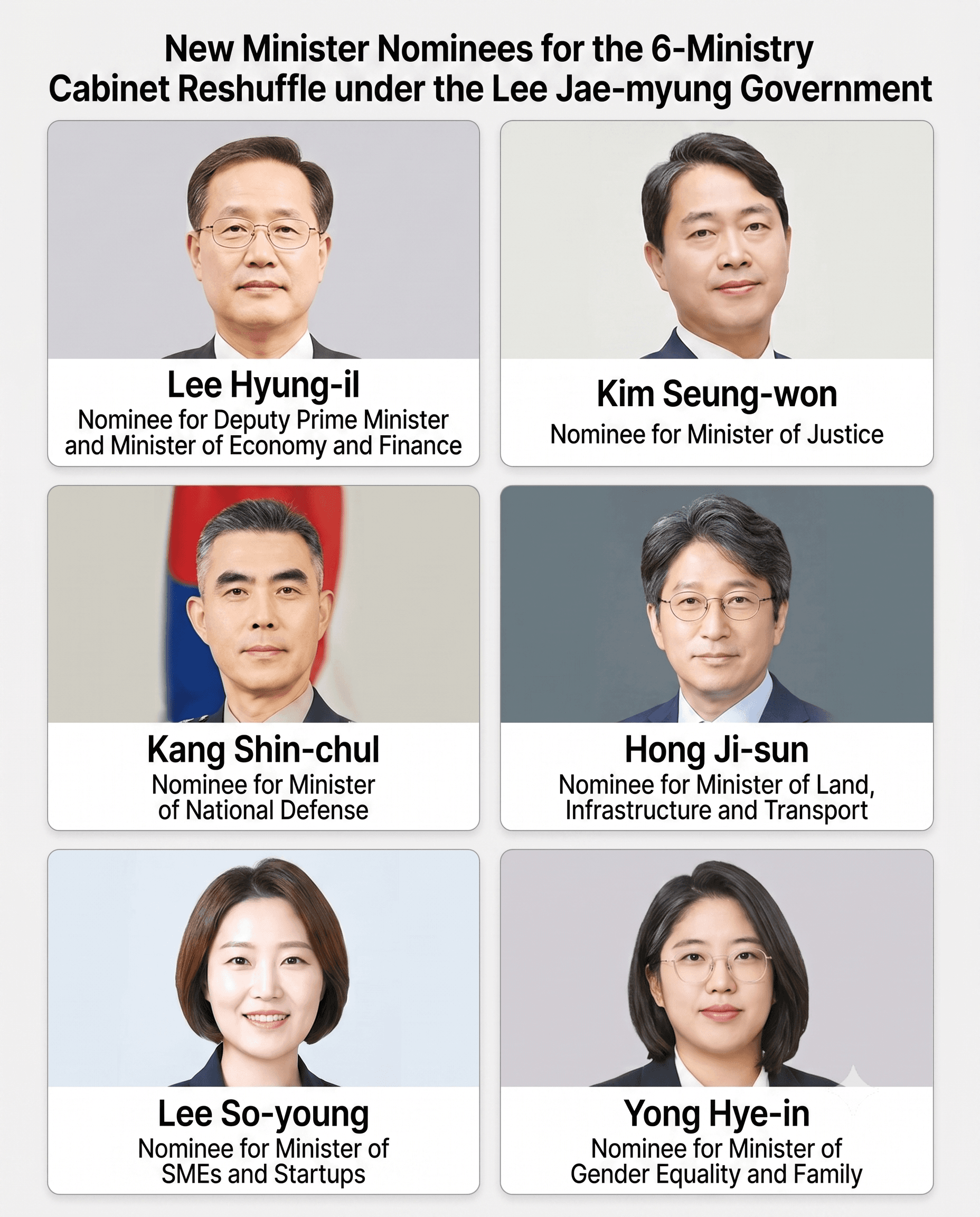
Lee Hyung-il, the First Vice Minister of Economy and Finance, was tapped as Deputy Prime Minister and Minister of Economy and Finance, taking over from Koo Yun-cheol. Known as an agile macroeconomic strategist who led emergency price controls during global oil shocks, Lee pledged to steer the economy toward structural revitalization.
"I carry a profound sense of responsibility taking on the role of the administration's second economic commander," Lee said. "We will concentrate on the 'Three Mega Projects' to unlock new investment and growth drivers, establishing a firm bedrock for our potential growth rate to rebound."
Similarly, Hong Ji-sun, the Second Vice Minister of Land, Infrastructure, and Transport, was promoted to head the ministry. Having directed urban and housing policies in Gyeonggi Province, Hong is tasked with untangling bottlenecks in the real estate sector. The presidential office underscored that Hong possesses the hands-on expertise to "swiftly supply housing in areas where public demand is most urgent."
Legislative Drivers and an Expanded Progressive Coalition
For ministries requiring delicate inter-party mediation and aggressive reform mandates, the administration drafted frontline lawmakers, deliberately expanding its bench beyond the ruling Democratic Party (DP).
• Ministry of Justice: Representative Kim Seung-won, a former judge and the ranking DP member on the National Assembly’s Legislation and Judiciary Committee, was nominated to head the ministry. Kim, who led the party’s initiatives on judicial restructuring, is expected to firmly anchor the post-reform criminal justice framework.
• Ministry of SMEs and Startups: Representative Lee So-young, a two-term DP lawmaker with recognized expertise in climate economics and industrial policy, was tapped to lead venture and small-business innovation.
• Ministry of Gender Equality and Family: Representative Yong Hye-in, the 1990-born floor leader of the minor opposition Basic Income Party, was nominated. If confirmed, Yong will become the youngest cabinet minister in the current government, embodying a generational shift in state governance.
The presidential office also revamped its core advisory apparatus. Representative Lee Hae-min of the Rebuilding Korea Party, a former Google product manager, was named Senior Presidential Secretary for AI and Future Planning. Ha Jung-woo, the outgoing AI secretary, was reassigned as Vice Chairman of the National AI Strategy Committee. To manage mega-industrial policies, Lee Won-joo from the Ministry of Climate, Energy and Environment was designated as Special Aide for Mega Projects, while pro-Moon political heavyweight Kim Kyoung-soo, former chairman of the Local Era Committee, was appointed Special Presidential Advisor for Political Affairs.
Return of Four-Star General to Steer National Defense
The defense portfolio underwent a decisive realignment with the nomination of Kang Shin-chul, a retired four-star Army general and current Ambassador to Saudi Arabia.
A graduate of the Korea Military Academy (KMA) who served as Deputy Commander of the ROK-U.S. Combined Forces Command (CFC) and Chief of the Joint Chiefs of Staff Operations Headquarters, Kang returns to uniform leadership after stepping down during last year's leadership reshuffle. Kang is slated to oversee sensitive security agendas, including the integration of the three service academies and the conditions-based transition of wartime operational control (OPCON).
Kang replaces Ahn Gyu-baek, the nation's first civilian defense minister in 64 years, who stepped down amid escalating pressure over historical draft controversies, defense readiness concerns, and an opposition-led impeachment petition backed by more than 330,000 citizens.
Partisan Clashes Ahead of September Confirmation Hearings
The multifaceted reshuffle has set the stage for intense political confrontations as the regular National Assembly session opens on September 1.
The ruling Democratic Party immediately lauded the nominations as a pragmatic lineup defined by "youth, specialized expertise, and progressive solidarity." DP leader Kim Min-seok noted that the appointments reflect the party's governing ethos of expanding policy frontiers, while party spokesperson Lee Yong-woo urged swift confirmation proceedings to eliminate administrative vacuums, warning the opposition against partisan obstruction.
The conservative opposition People Power Party (PPP) launched a scathing critique. PPP leader Jang Dong-hyuk lambasted the reshuffle, arguing that the administration had "seasoned the cabinet with pro-Moon and Cho Kuk loyalists like cheap condiments." PPP Floor Leader Jeong Jeom-sik characterized the legal and political appointments as an offensive designed to facilitate the dismissal of ongoing criminal indictments against ruling figures.
With parliamentary hearings imminent, the ultimate success of President Lee’s mid-term reshuffle will hinge on whether this reshuffled lineup can survive aggressive legislative vetting and deliver measurable economic and housing relief to the public.
TAP HERE for an English-Korean bilingual version. [영한대역으로 보려면 여기를 누르세요]