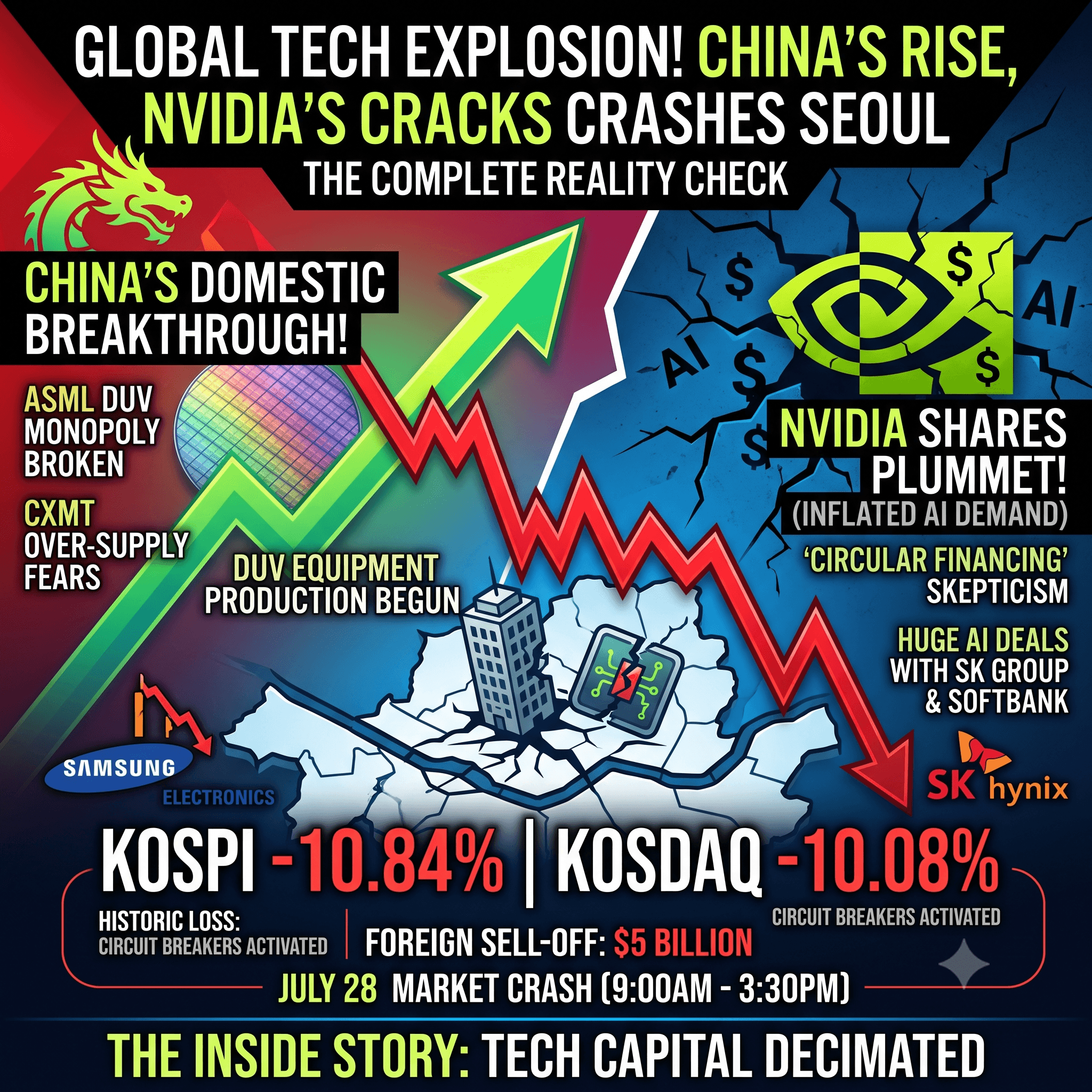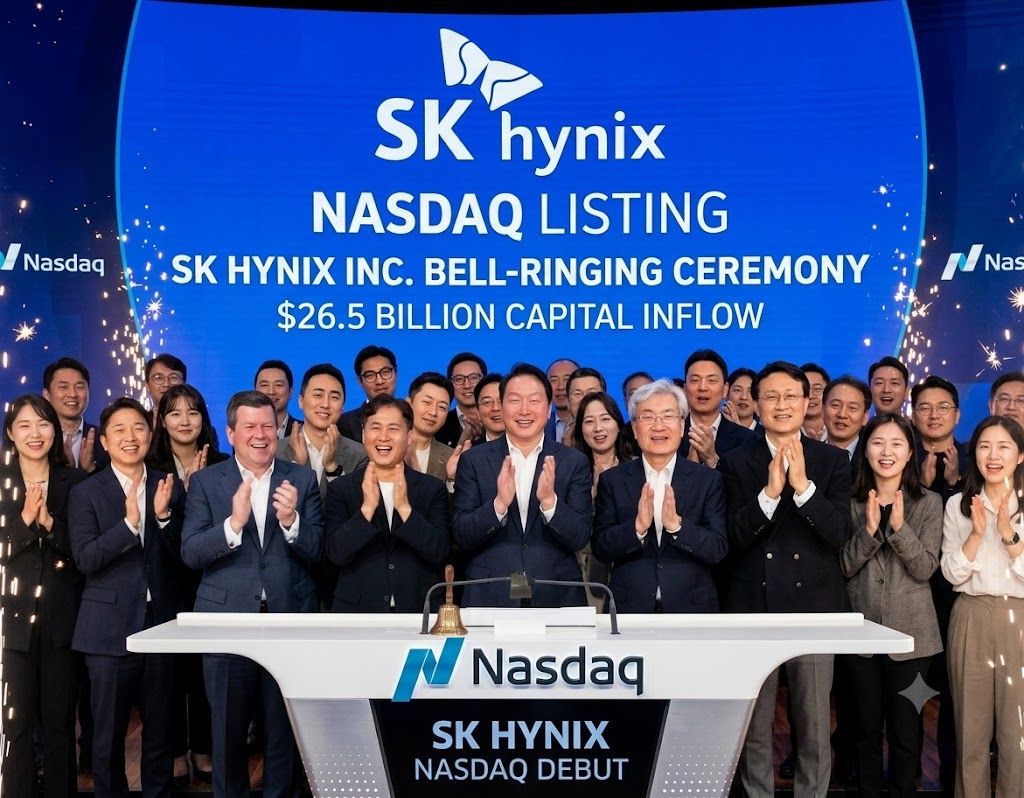
NEW YORK — In a financial maneuver that has sent shockwaves through both the global semiconductor industry and international currency markets, SK Hynix has officially marked its debut on the Nasdaq exchange. The historic listing, finalized today, has triggered an unprecedented capital inflow of $26.5 billion into South Korea. Macroeconomic experts and financial analysts are already drawing parallel lines between this massive dollar injection and a sovereign currency swap agreement, highlighting its immediate and profound stabilizing effect on the domestic foreign exchange market.
The listing, which represents one of the largest cross-border financial plays by a South Korean technology giant in recent history, comes at a highly critical juncture. As the global race for Artificial Intelligence (AI) supremacy intensifies, SK Hynix’s decision to tap into Wall Street’s deep liquidity pools is being hailed as a strategic masterstroke. The move not only secures the necessary financial ammunition for the company’s aggressive Next-Generation High Bandwidth Memory (HBM) development roadmap but also provides a robust, unexpected cushion for the Korean Won amid shifting macroeconomic headwinds.
A "Currency Swap" in All but Name
The comparison to a formal currency swap is far from mere financial hyperbole. Historically, South Korea has relied on bilateral currency swaps with major central banks, such as the US Federal Reserve, to calm volatile foreign exchange markets during times of global economic uncertainty or sudden capital flight. However, the direct inflow of $26.5 billion via global institutional investor subscriptions achieves a remarkably similar outcome without any of the geopolitical strings or reciprocal obligations usually attached to sovereign agreements.
As the newly raised dollars began flowing into the domestic banking system following the closing bell, the Korean Won experienced an immediate relief rally, erasing weeks of stubborn depreciation fears against the greenback. "The sheer volume of this capital injection acts as an immediate, private-sector firewall for the local currency," noted a senior economist at a major financial institution. "While a traditional central bank currency swap is a temporary emergency lifeline that must eventually be repaid or dismantled, this is permanent investment capital pouring directly into the nation’s core industrial asset. In many ways, it is fundamentally healthier for the country's balance of payments than a standard liquidity agreement."
Fueling the AI Memory War
Beyond the macroeconomic relief it offers to the nation, the primary driver behind this Nasdaq listing remains SK Hynix's relentless pursuit of absolute dominance in the ultra-competitive AI memory sector. The company, which currently holds a commanding lead in supplying advanced HBM chips to silicon pioneers like Nvidia, requires astronomical capital expenditures to scale up its production facilities and fund cutting-edge research and development, particularly for the upcoming HBM4 architecture and advanced packaging technologies.
By choosing the Nasdaq over local exchanges for this specific corporate action, SK Hynix has effectively embedded itself into the very heart of the global technology investment ecosystem. Wall Street investors, notoriously bullish on AI infrastructure, have shown a willingness to grant premiums and valuations that domestic markets traditionally struggle to match. The $26.5 billion war chest will immediately be deployed to accelerate the construction of the massive Yongin Semiconductor Cluster and expand advanced foundry partnerships, ensuring that the company stays a decisive step ahead of rivals like Samsung Electronics and Micron Technology.
Institutional Enthusiasm and Market Repercussions
The global appetite for SK Hynix’s Nasdaq shares comfortably defied initial conservative estimates. Global asset managers, sovereign wealth funds, and tech-focused venture funds reportedly oversubscribed the offering within the first forty-eight hours of the book-building process. This intense interest underscores a broader consensus among institutional investors: the ongoing AI revolution is fundamentally unsustainable without the advanced, high-performance memory architectures that SK Hynix specializes in manufacturing.
Domestically, the reaction has been a healthy mix of national pride and tactical re-evaluation. While some market purists expressed minor concerns over the potential dilution of domestic market influence, the overwhelming sentiment remains highly positive. The influx of foreign currency is expected to alleviate lingering pressure on the Bank of Korea's foreign reserves, granting monetary policymakers significantly greater flexibility in managing domestic interest rates and combatting inflation throughout the latter half of 2026.
A New Paradigm for South Korean Conglomerates
SK Hynix’s successful Nasdaq venture may well signal a permanent paradigm shift for other major conglomerates in South Korea. For decades, the so-called "Korea Discount"—a phenomenon where South Korean companies suffer lower market valuations compared to global peers due to unique governance structures and geopolitical risks—has plagued local enterprises. By directly listing on a premier US exchange, SK Hynix has effectively bypassed this traditional hurdle, setting a powerful and repeatable precedent for how high-tech firms from middle-power economies can directly leverage global capital markets.
As the dust settles on this historic listing, the focus of the market now shifts entirely to execution. With $26.5 billion in fresh capital and the eyes of global investors firmly fixed on its quarterly earnings reports, SK Hynix is no longer just a vital cog in the South Korean economy—it has officially cemented its status as an indispensable, institutional pillar of the global technology landscape.