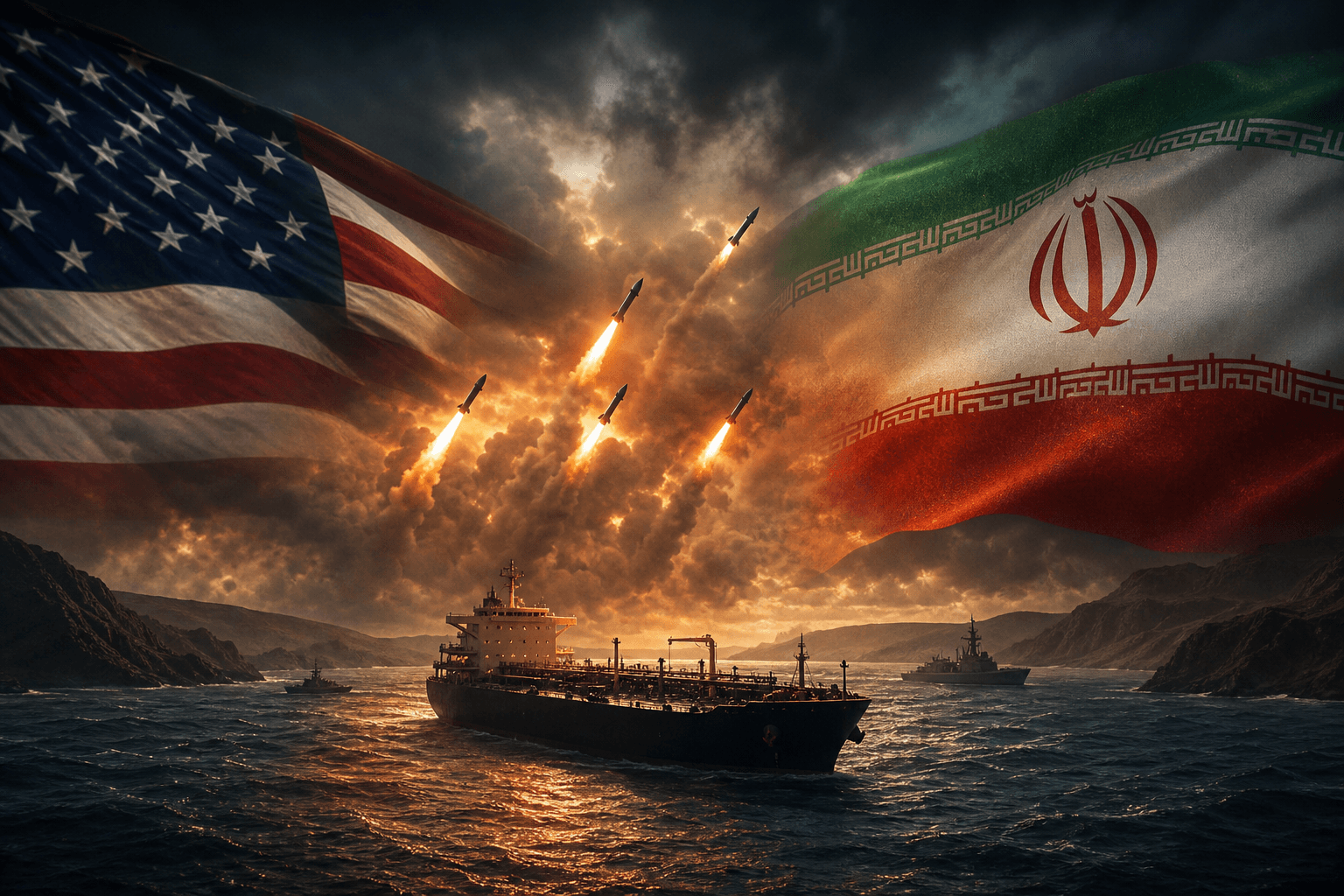
Iran said Monday that it had launched a new wave of missile and drone attacks against U.S. military naval assets in the Middle East after fresh U.S. strikes on sites in Iran. According to U.S. Central Command, the U.S. attacks targeted air defense systems, radar sites, missile and drone equipment, and small boats, which Washington said were being hit to reduce Iran’s ability to threaten civilian mariners and commercial vessels transiting the Strait of Hormuz. U.S. Central Command also said it had struck 140 targets, including launch sites, ammunition dumps and communications equipment.
Iranian media said ballistic missiles were launched from western and central Iran toward U.S. bases and vessels. Missile alert sirens were heard in Bahrain, which hosts the U.S. Navy’s 5th Fleet, while Kuwait said it had intercepted hostile fire and Jordan said it had downed four Iranian missiles. Iran’s Revolutionary Guard said strikes hit facilities in Juffair, Bahrain, and destroyed two radars in Oman, and Iran’s state news agency IRNA reported that U.S. facilities in Kuwait were heavily damaged. Those Iranian claims had not been independently confirmed in the reporting.
The fighting has further clouded the status of the Strait of Hormuz, a critical energy shipping route. Iran’s Revolutionary Guard said the waterway is Iranian territory and claimed it had been closed again, while the United States has said the strait is open. A June 17 memorandum of understanding between Washington and Tehran had partially reopened traffic after earlier wartime disruption, but not to pre-war levels. Intelligence platform Kpler said confirmed crossings through the strait fell by about 52 percent week on week over July 10 to 12, with vessel traffic reverting to more defensive routing patterns.
The conflict is also affecting civilians in southern Iran. Residents in Bandar Abbas and Sirik told The Guardian that recent U.S. strikes brought repeated nighttime explosions and rising fear about further attacks. Iranian authorities said at least 14 people were killed and more than 78 injured over two days of attacks cited in that report. Residents also described pressure on daily life, including damage to water facilities in the Sirik area and concern among fishing and maritime communities whose livelihoods depend on staying near the coast.
Political pressure is also emerging in Washington. Senate Democratic leader Chuck Schumer publicly criticized the escalation and called on President Donald Trump to follow congressional votes aimed at withdrawing U.S. forces, according to Crypto Briefing. More broadly, the latest exchanges appear to extend a cycle of tit-for-tat military action that, according to reporting citing Press TV, has characterized the U.S.-Iran conflict since early 2026, with concerns growing about further escalation across the region.