
To see the announcement video of the 2026 Nobel Prize in Physics, click here.
Click here to watch the World Science Festival's detailed explainer.
STOCKHOLM — To put the 2026 Nobel Prize in Physics simply: Francis Halzen won because he turned a massive chunk of Antarctic ice into a cosmic telescope to catch the universe’s most elusive ghost particles.
While traditional astronomers look up at the night sky to catch faint starlight, Halzen drilled 2.5 kilometers straight down into the South Pole ice sheet to capture high-energy cosmic neutrinos.
This single breakthrough officially unlocked "neutrino astronomy," giving humanity an entirely new cosmic eye to look straight into violent, extreme deep-space events that normal light could never reveal.

Wait, What Is a Neutrino? And How Is It Different from a Neutron?
Many people hear the name and ask: "Wait, is a neutrino just a tiny neutron inside an atom?" The short answer is: absolutely not.
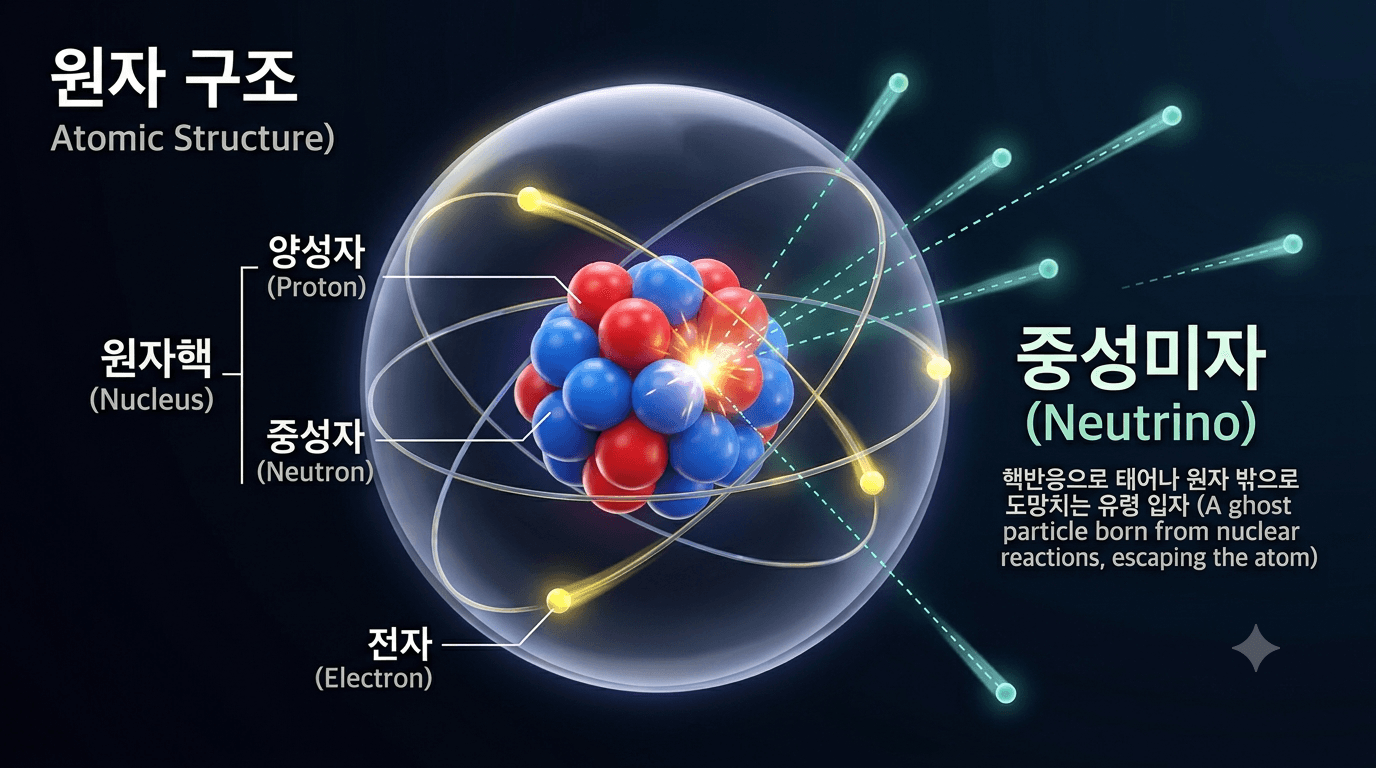
In basic atomic structure, an atom consists of a central nucleus made of protons and neutrons, with electrons orbiting around it.
Neutrons are heavy housekeepers nestled firmly inside the atomic nucleus, bound together by quarks to keep the atom stable.
Neutrinos, on the other hand, do not live inside the atom at all.
They are fundamental particles born only in split-second nuclear reactions—such as nuclear fusion, radioactive decay, or exploding supernovas—instantly escaping the atom and sprinting through space at nearly the speed of light.
Because they have zero electric charge and almost zero mass, roughly 60 billion neutrinos pass straight through your thumbnail every single second without bumping into a single cell.
What Do We Actually Gain by Catching It?
Since neutrinos interact with practically nothing, catching them sounds completely pointless—until you realize what that transparency allows.
First, it is an uncorrupted cosmic black box: while light gets scattered by thick interstellar dust and charged cosmic rays are warped by galactic magnetic fields, neutrinos fly straight to Earth without a scratch.
Second, it acts like a cosmic CT scan: while light produced at the sun’s core takes over 100,000 years to bounce its way to the surface, neutrinos blast out of the sun's fiery core in just 2 seconds, offering a real-time live feed of nuclear furnaces.
Third, this penetrating power is opening up futuristic applications right here on Earth, from remotely inspecting clandestine nuclear reactors through feet of solid concrete, to mapping magma reservoirs deep inside the Earth’s mantle.
Scientists at Fermilab even managed to transmit digital data straight through hundreds of meters of solid rock using a neutrino beam, proving that one day we could send messages clean through the center of planet Earth to submarines deep under the ocean.
The Mad Genius Solution: "Let's Use 1 Billion Tons of Antarctic Ice"
The headache was that because neutrinos are the ultimate introverts, catching them in an ordinary lab detector is practically impossible.
That’s when Francis Halzen pitched his hilariously bold brute-force idea: "If the odds of a hit are one in a trillion, let's just make the detector the size of a mountain!"
Deep underneath the South Pole, crushing glacial pressure squeezes out every single air bubble, leaving a cubic kilometer of ice that is pitch-black and clearer than diamond.
When a high-energy neutrino traveling across the cosmos miraculously crashes head-on into a water molecule in this ice, it kicks out a secondary particle moving faster than the local speed of light.
This produces Cherenkov radiation—the optical equivalent of a jet breaking the sound barrier—flashing an eerie, gorgeous blue light throughout the glacier.
Sensors frozen inside the ice catch this microsecond blue flash, allowing scientists to calculate the exact direction and locate the supermassive black hole that fired it billions of light-years away.
Extreme Engineering: Drilling 2,450 Meters with Boiling Water
Turning a glacier into a giant particle observatory sounded like science fiction, and building it was pure madness.
Braving biting winds and minus 50-degree Antarctic blizzards, the team blasted water heated to over 80°C down into the ice sheet, taking over 40 hours just to melt a single 2,450-meter-deep vertical shaft.
They drilled 86 of those holes and swiftly lowered cables lined with over 5,160 basketball-sized optical sensors (DOMs) into the abyss before the slush could freeze.
Because the Antarctic cold instantly refroze the water into solid permanent ice, no sensor could ever be pulled back up for repairs: it was an all-or-nothing, one-way ticket into the ice.
The Visionary: Who Is Francis Halzen?
• Born: March 23, 1944, in Tienen, Belgium
• Education: B.S., M.S., and Ph.D. in Physics from KU Leuven (1969)
• Key Career: Researcher at CERN (1969–1971), Professor at University of Wisconsin–Madison (1972–present), Principal Investigator of the IceCube Project
Halzen started out as an orthodox theoretical physicist who calculated formulas for quarks and elementary particles on a quiet chalkboard with pencil and paper.
In the 1970s, he realized that human-made accelerators on Earth could never match the titanic energies spat out by cosmic monsters, and boldly decided to chase cosmic neutrinos instead.
When attempts to sink detectors into the Hawaiian ocean failed, Halzen boldly pivoted to the solid, unyielding ice sheet of Antarctica in the late 1980s.
For more than three decades, he weathered sub-zero blizzards, technical nightmares, and cynical skeptics, ultimately building the world's largest particle telescope.
A Standing Ovation for the Ultimate Ice Gamble
When everyone else was looking up at the sky to dream of the stars, one scientist dug into the frozen ground to haul up the secrets of the cosmos.
The 2026 Nobel Prize in Physics is the world’s standing ovation for a mad visionary whose impossible ice gamble permanently broadened humanity’s horizon on the universe.
Next time you hear an ice cube clink inside your iced Americano, take a moment to smile: somewhere deep beneath the Antarctic ice, those very same frozen crystals are still catching blue flashes from the farthest corners of our universe.
TAP HERE for an English-Korean bilingual version. [영한대역으로 보려면 여기를 누르세요]