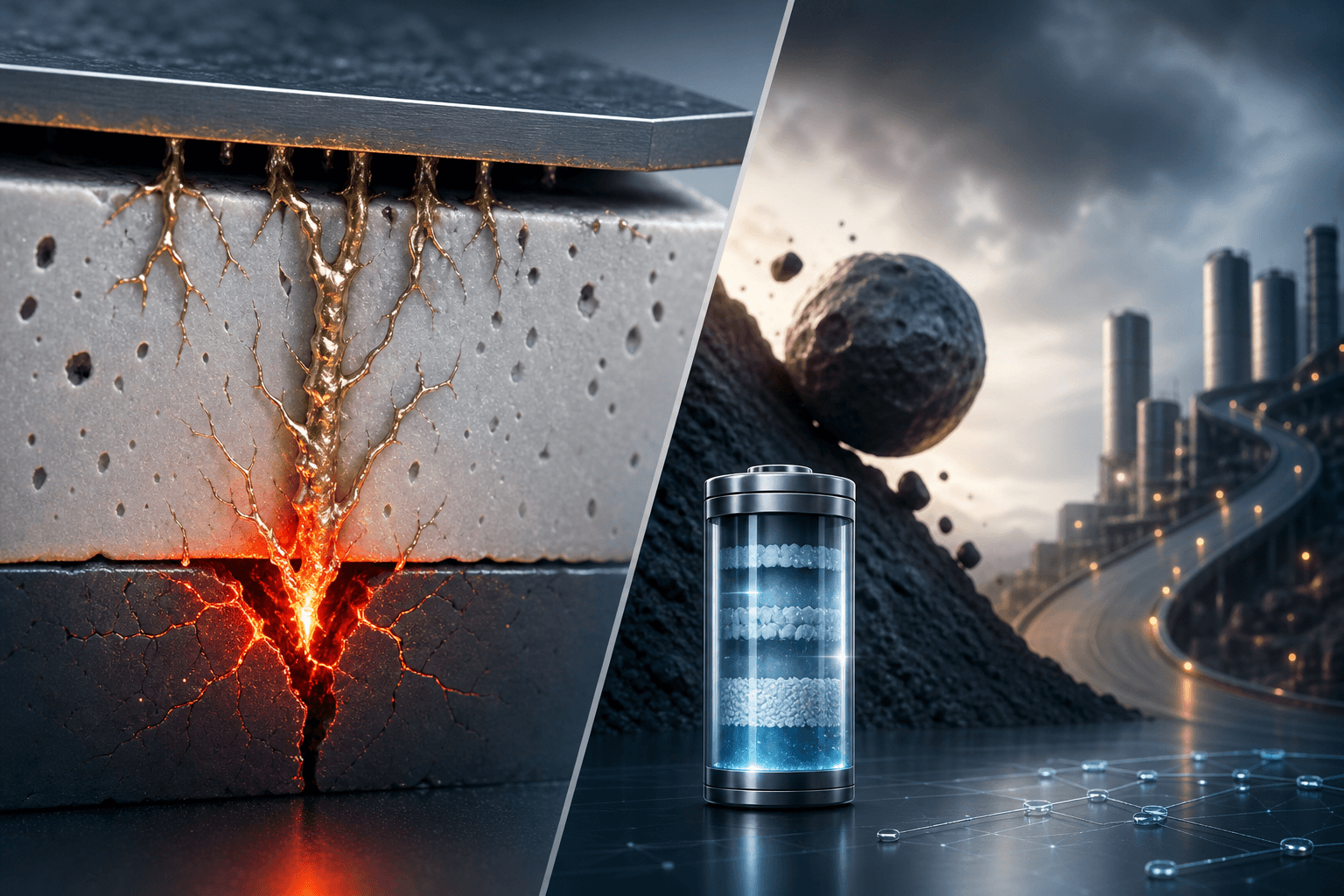
Researchers at the Max Planck Institute for Sustainable Materials have identified a mechanism they say explains a longstanding failure mode in solid-state batteries, a technology widely viewed as a potential successor to conventional lithium-ion cells. In a study published in Nature, the team reported that soft lithium dendrites can penetrate hard ceramic electrolytes through hydrostatic stress that ultimately causes brittle fracture, leading to internal short circuits. The finding addresses a central question that has slowed efforts to bring solid-state batteries into wider commercial use.
The researchers examined why lithium dendrites, despite being made of soft metal, are able to crack stiff ceramic materials inside a battery. They tested competing explanations for the process using sample preparation and characterization techniques carried out under vacuum and at cryogenic temperatures to avoid interference from oxygen, water, or electron beams. Their analysis found no buildup of lithium ahead of the dendrite tip, which ruled out one previously proposed explanation. Lead author Yuwei Zhang said the team concluded that hydrostatic stress within the dendrite drives fracture of the solid electrolyte, a result the group said was also supported by phase field simulations and electron backscatter diffraction measurements.
The group said the work could help guide engineering strategies aimed at reducing failure. Possible approaches under investigation include making solid electrolytes tougher, adding microscopic voids to redirect dendrite growth and crack paths, and applying protective coatings to lithium electrodes to limit dendrite formation. Supporters of solid-state technology argue that if such obstacles can be managed, the batteries could offer higher energy density, improved safety, and longer life than current lithium-ion designs, with potential applications in smartphones, electric vehicles, and other electronics.
At the same time, analysts and battery researchers say solid-state batteries remain only one part of a broader and still-evolving storage market. Industry forecasts cited by analysts place vehicle-ready solid-state products several years away, with companies such as Toyota, Nissan, Solid Power, QuantumScape, CATL, BMW, Ford, and Honda pursuing different approaches. Analysts also say manufacturing remains difficult and costly, and that commercialization is likely to be gradual rather than immediate. Broader market trends suggest lithium-ion batteries will continue to dominate in the near term, while sodium-ion batteries may expand in lower-cost vehicles and grid storage, underscoring that advances in solid-state performance do not by themselves guarantee rapid mass adoption.