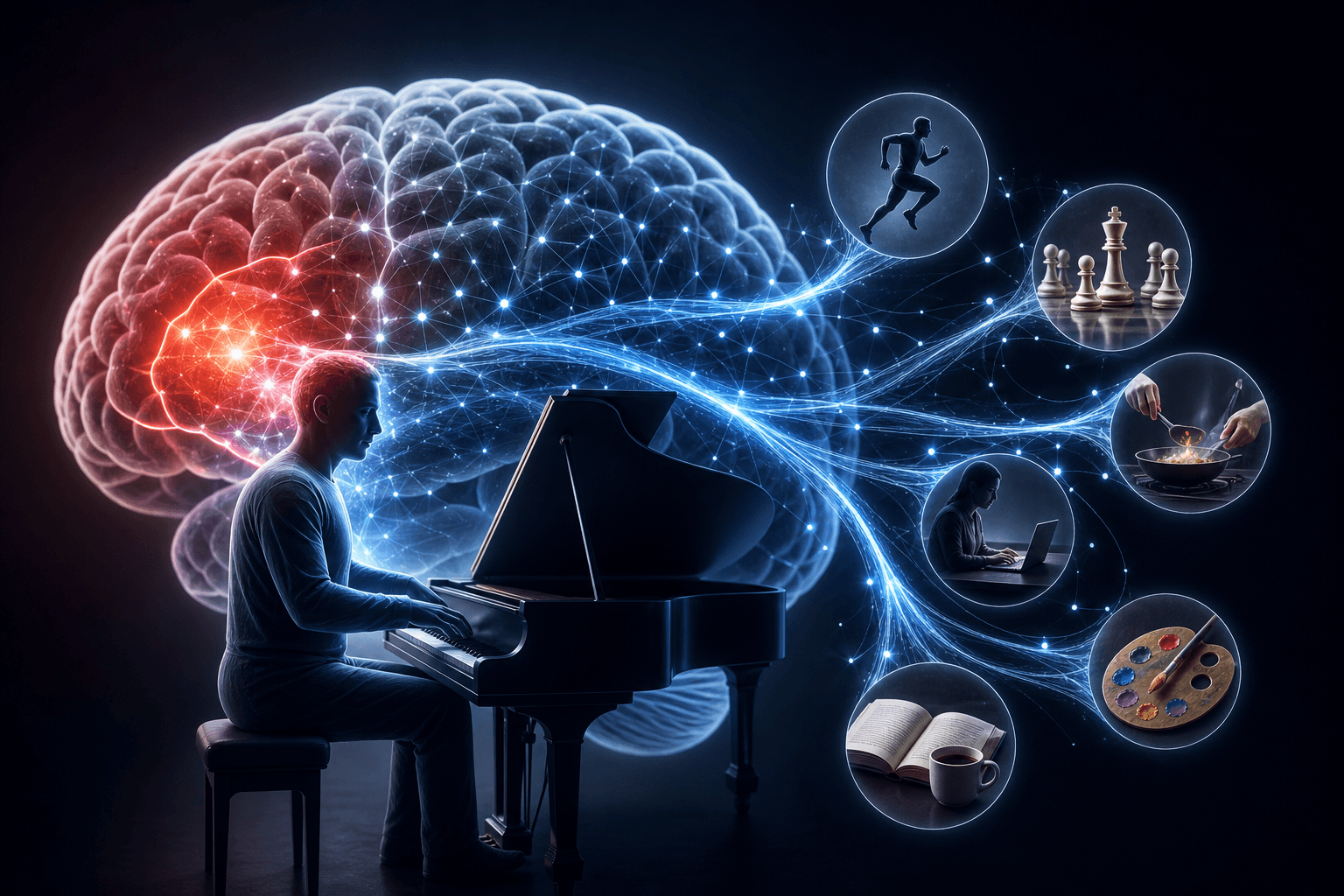
Researchers at Georgetown University Medical Center reported that extensive practice can reorganize how the brain processes a learned task, potentially allowing people to perform that task alongside another one more effectively. The study, published in the Journal of Cognitive Neuroscience, tracked volunteers as they completed more than 30,000 trials of a car-image sorting exercise over five to 10 weeks. Brain scans taken before and after training showed that the task initially relied mainly on the prefrontal cortex, but later was handled largely by the temporal cortex.
The researchers used fMRI and EEG to examine the change. They said the results suggest that, with enough experience, the brain can move a practiced task out of regions associated with planning and conscious control and into more specialized circuits involved in memory and object recognition. Maximilian Riesenhuber, a Georgetown neuroscientist and senior author of the study, said that shift appears to bypass what he described as a frontal bottleneck, leaving the prefrontal cortex freer to manage other demands.
The team also found that participants performed better on a second task at the same time when the car-sorting work had been more fully offloaded from the prefrontal cortex. Based on that result, the researchers argue the findings challenge the long-standing view that humans do not truly multitask and instead only switch attention rapidly between activities. First author Patrick Cox said the longitudinal design was a key feature because it allowed the team to observe the neural change before and after training rather than only studying experts after the fact.
The researchers said the findings could have broader implications for understanding habit formation, compulsive behavior and the limits of current artificial intelligence systems. Riesenhuber argued that once a behavior is embedded in circuits less dependent on conscious control, simply trying to think about something else may not be enough to break it. Cox said the work may also help explain highly trained professional judgments, such as radiologists classifying X-ray findings with little apparent deliberation. The team said future research will examine what signals drive the shift between brain regions and which tasks can eventually be carried out in parallel, while stressing that some combinations of activities, including texting while driving, would still not be safe.