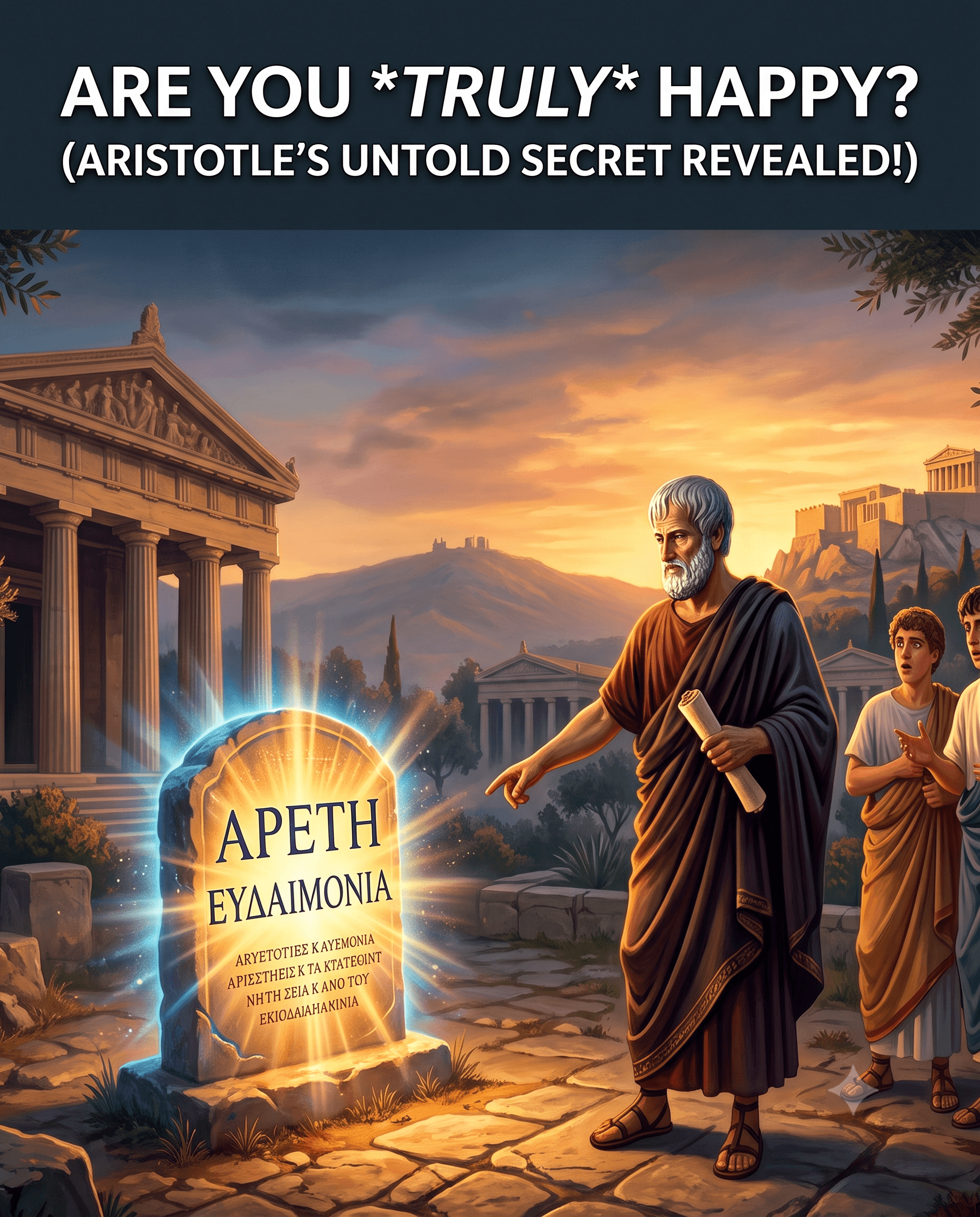
Have you ever looked back on your day and asked yourself, "Was I truly happy today?"
The dopamine-filled pleasure we feel when enjoying delicious food or binge-watching Netflix over the weekend is certainly a part of happiness. However, once such momentary pleasures fade away, a sense of emptiness often lingers in a corner of our hearts.
Over 2,400 years ago, the great ancient Greek philosopher Aristotle (B.C. 384 ~ B.C. 322) saw straight through this very dilemma. He maintained that true human happiness is not a fleeting emotional state, but rather stems from the lifelong exercise of 'excellence (aretē, ἀρετή)'.
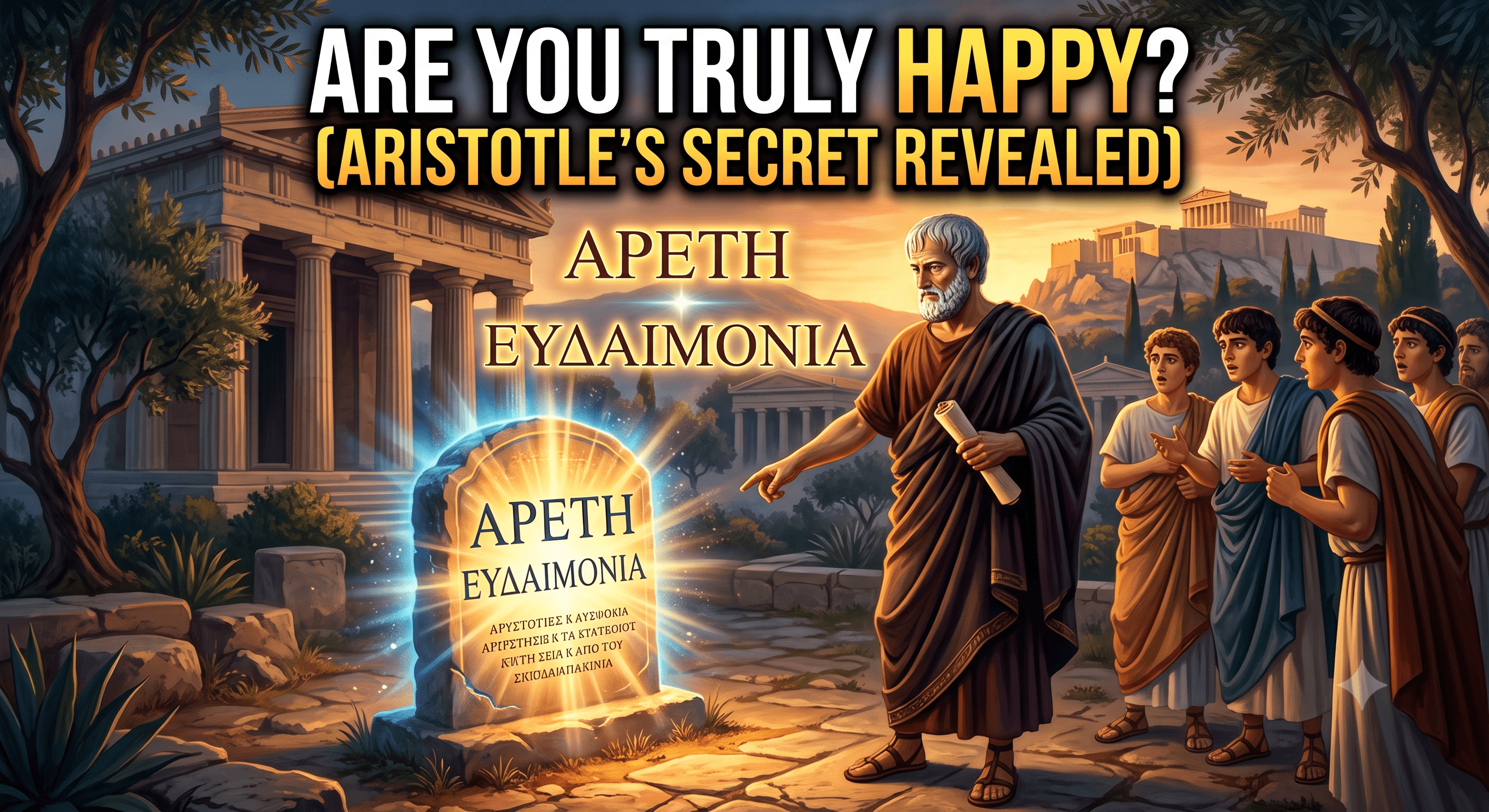
Why did he single out 'excellence' as the absolute prerequisite for happiness? Let us explore his profound insights through a modern lens, grounded in his seminal work, the Nicomachean Ethics (Ēthika Nikomacheia, Ἠθικὰ Νικομάχεια).
1. Everything Moves Toward a Purpose: Telos and Ergon
The starting point of Aristotle's philosophy is teleology. This is the idea that every object and living thing in the world has an ultimate end, or telos (τέλος), that it strives to achieve.
• The purpose of an acorn: To endure wind and rain beneath the soil and grow into a majestic oak tree.
• The purpose of a knife: To cut through objects cleanly and sharply.
• The purpose of a flute: To resonate with beautiful, clear melodies.
What, then, does an entity need to fully achieve its ultimate purpose? It must perform its unique, inherent function—its ergon (ἔργον)—with the highest degree of excellence. If a knife is too dull to even slice paper, it loses its worth as a knife; only when it cuts smoothly like a master blade does it fulfill its proper function.
Aristotle referred to this state—"when an object or entity performs its unique function most excellently"—as aretē (ἀρετή, excellence/virtue).
2. 'Aretē' Is Not Simply Moral Goodness
We usually associate 'virtue' with moral sacrifice—suppressing our desires and yielding to others. However, the original meaning of the ancient Greek word aretē extends far beyond mere moral innocence. Rather, it is much closer to 'outstanding capability,' 'the maximization of potential,' and 'the exhibition of peak performance.'
• A horse that runs fast possesses the 'aretē of running.'
• A physician who treats patients exceptionally well possesses the 'aretē of medicine.'
• A teacher who accurately unlocks a student's potential possesses the 'aretē of education.'
What, then, is "aretē as a human being"?
Aristotle identified reason (logos, λόγος) as the definitive and unique function that sets human beings apart from other animals. Simply eating, sleeping, and reproducing are things plants and animals can do as well. Only humans can contemplate, discern, establish meaningful goals, and govern themselves.
Therefore, human excellence (aretē) means the power to fully cultivate one's rational faculties and make the best possible choices in every moment of life.
3. Happiness (Eudaimonia) Is an 'Activity (Energeia)', Not an Emotion
Aristotle called the ultimate end of all human action and the supreme good (summum bonum) eudaimonia (εὐδαιμονία). While often translated as 'happiness', its true essence is captured much more accurately in modern psychology as 'self-actualization' or 'human flourishing.'
He never equated true happiness with passive 'feelings' or sensual pleasure (hēdonē, ἡδονή).
"Happiness is an activity of the soul in accordance with complete excellence (aretē)."
— Nicomachean Ethics
Happiness is not the idle contentment you feel when lounging in bed after winning the lottery. It emerges exclusively through dynamic action—energeia (ἐνέργεια, actuality/activity)—wherein you pour your utmost capabilities into creating something, wisely resolving difficult challenges, and cultivating meaningful human relationships.
Much like the thrill an instrumentalist experiences during a flawless performance after years of practice, or the profound joy a scholar feels when uncovering a truth after sleepless nights, humans reach profound eudaimonia only when they fully express their unique excellence.
4. The Two Wings That Complete Excellence: Habit (Ethos) and the Mean (Mesotēs)
Such excellence does not simply fall from the sky one day. Aristotle presented two practical instruments for acquiring excellence:
① Constant Repetition and Habituation: Ethos (ἦθος)
"We are what we repeatedly do. Excellence, then, is not an act, but a habit."
Excellence of character (ēthikē aretē) is not acquired through rote memorization of knowledge, but is built through the accumulation of daily actions. Just as one becomes a builder by building houses and a harpist by playing the harp, one becomes just only by practicing just actions.
② The Wisdom to Strike the Dead Center of the Target: The Mean (Mesotēs, μεσότης)
The practical standard of excellence is the golden mean (mesotēs). This is not a mechanical fifty-fifty compromise, but rather the art of finding the optimal balance in every situation by steering clear of both excess and deficiency.
• Cowardice (Deficiency) < Courage (Mean, Aretē) < Rashness (Excess)
• Stinginess (Deficiency) < Generosity (Mean, Aretē) < Extravagance (Excess)
• Servility (Deficiency) < Proper Pride (Mean, Aretē) < Arrogance (Excess)
The faculty to discern the appropriate emotional and behavioral balance suited to any given circumstance is called practical wisdom (phronēsis, φρόνησις). When we possess this insightful vision, we can make truly excellent choices without wavering at every crossroad.
5. Why Aristotle Again in the 21st Century?
In an era plagued by endless comparison and dopamine addiction, we frequently mistake "possessing more than others" or "consuming more comfortably" for true happiness.
Yet the message Aristotle delivered 2,400 years ago remains crisp and profound:
"Inside you lies a unique seed of potential (dynamis) that only you can bring to bloom in this world. The very process of cultivating that seed into its finest blossom (energeia) is aretē (excellence) and the highest happiness (eudaimonia) a human being can experience."
Why not start today with one small habit that awakens the dormant excellence within you, free from comparison with others? When small daily practices accumulate, our lives will already stand right at the center of the most radiant happiness.
TAP HERE for an English-Korean bilingual version. [영한대역으로 보려면 여기를 누르세요]
#ASpoonfulOfPhilosophy #Aristotle #NicomacheanEthics #Arete #Eudaimonia #GoldenMean #Humanities #LifePhilosophy #SelfImprovement #HappinessTheory