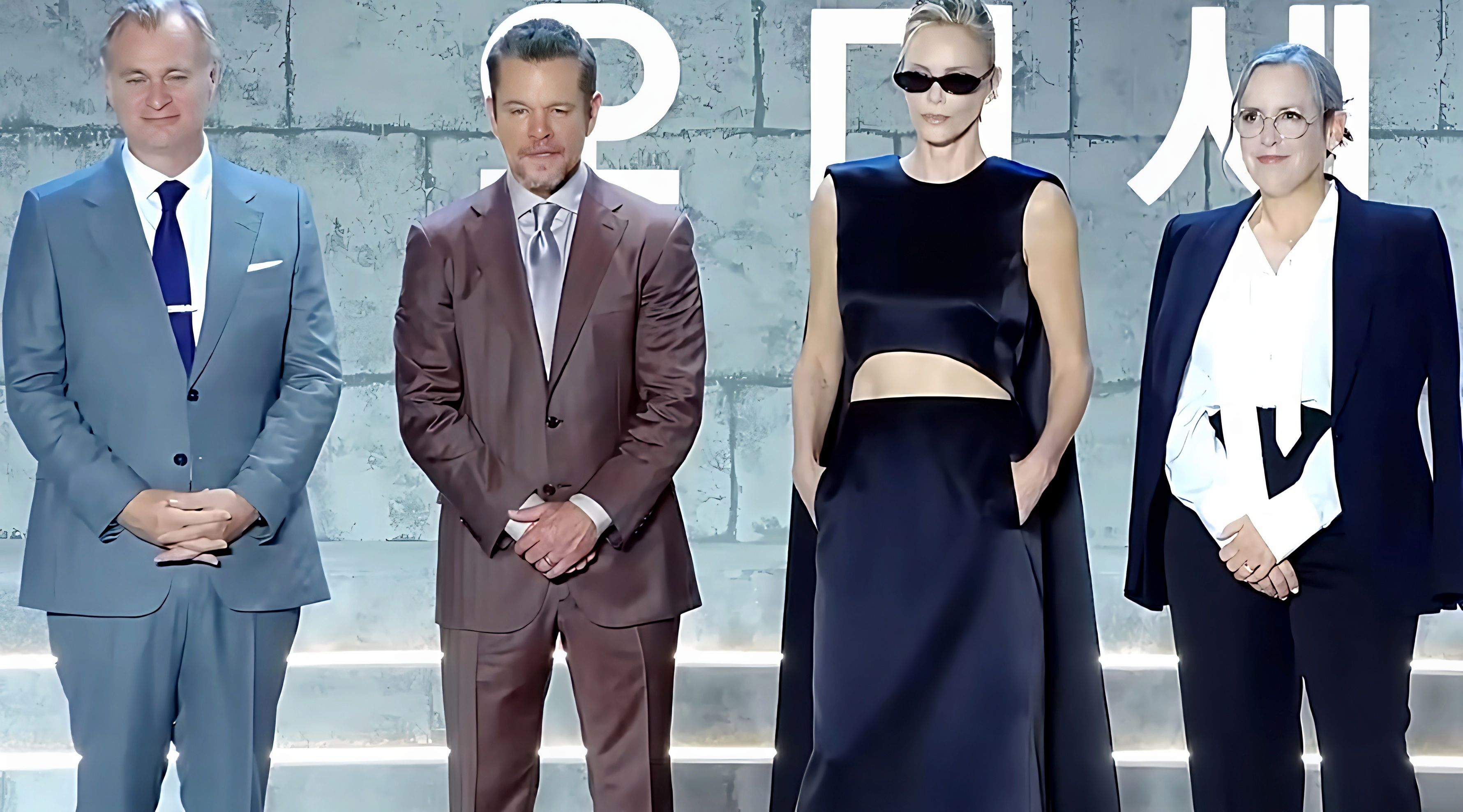
SEOUL — Christopher Nolan’s cinematic spectacle The Odyssey has taken the Korean box office by storm, officially surpassing the landmark 1 million admissions threshold within days of its nationwide release. The monumental milestone follows a sensational red-carpet event in Seoul, where director Christopher Nolan, accompanied by the film’s lead cast, visited South Korea to directly connect with one of the most passionate cinephile communities in the world.

During the press conference and fan screening held in Seoul, Nolan expressed deep gratitude to the Korean audience, noting that the country's profound appreciation for cinematic art and IMAX storytelling has always held a special place in his creative journey. The cast shared unforgettable moments with thousands of cheering fans, detailing the grueling yet exhilarating process of bringing Homer’s 3,000-year-old epic to life under Nolan’s meticulous direction.
The Odyssey: Christopher Nolan’s Grandest Leap Across the Cosmic and Human Horizon
When Christopher Nolan announces a new cinematic venture, the film industry routinely holds its breath.
From the mind-bending corridors of Inception to the haunting atomic realism of Oppenheimer, Nolan has continuously redefined the boundaries of blockbuster filmmaking.
Yet, his latest ambition—a sweeping, silver-screen adaptation of Homer’s ancient Greek epic, The Odyssey—represents a monumental leap into territory both historically foundational and visually uncharted.
By taking humanity’s oldest surviving adventure and subjecting it to his trademark IMAX precision and non-linear narrative mastery, Nolan is not merely directing a movie; he is re-engineering the very DNA of epic storytelling.
At its core, The Odyssey tells the legend of Odysseus (Matt Damon), the cunning King of Ithaca, who spends ten grueling years attempting to return home to his loyal wife Penelope (Anne Hathaway) and son Telemachus (Tom Holland) after the fall of Troy.

For a decade, he navigates treacherous seas and endures psychological torment, facing monstrous trials—from the intoxicating seven-year captivity by the nymph Calypso (Charlize Theron) on her isolated island of Ogygia, the flesh-devouring Cyclops Polyphemus (Javier Bardem), and the mesmerizing, fatal song of the Sirens, to the terrifying dilemma of choosing between Scylla and Charybdis.

Meanwhile, back in Ithaca, his kingdom slowly decays as ruthless suitors occupy his home, consuming his wealth and demanding Penelope’s hand in marriage.
In the hands of Nolan, this ancient heroic journey transforms from a standard mythical retold fable into a harrowing, visceral exploration of time, memory, and trauma.
Known for avoiding artificial green screens whenever possible, Nolan’s vision brings the Mediterranean to life through physical scale: real wooden vessels battling actual oceanic tempests, filmed on custom-built IMAX cameras.
Odysseus (Matt Damon) is stripped of modern superhero polish; instead, he is framed as a deeply flawed, battle-worn commander whose greatest weapon is not physical strength, but an relentless, agonizing intellect.
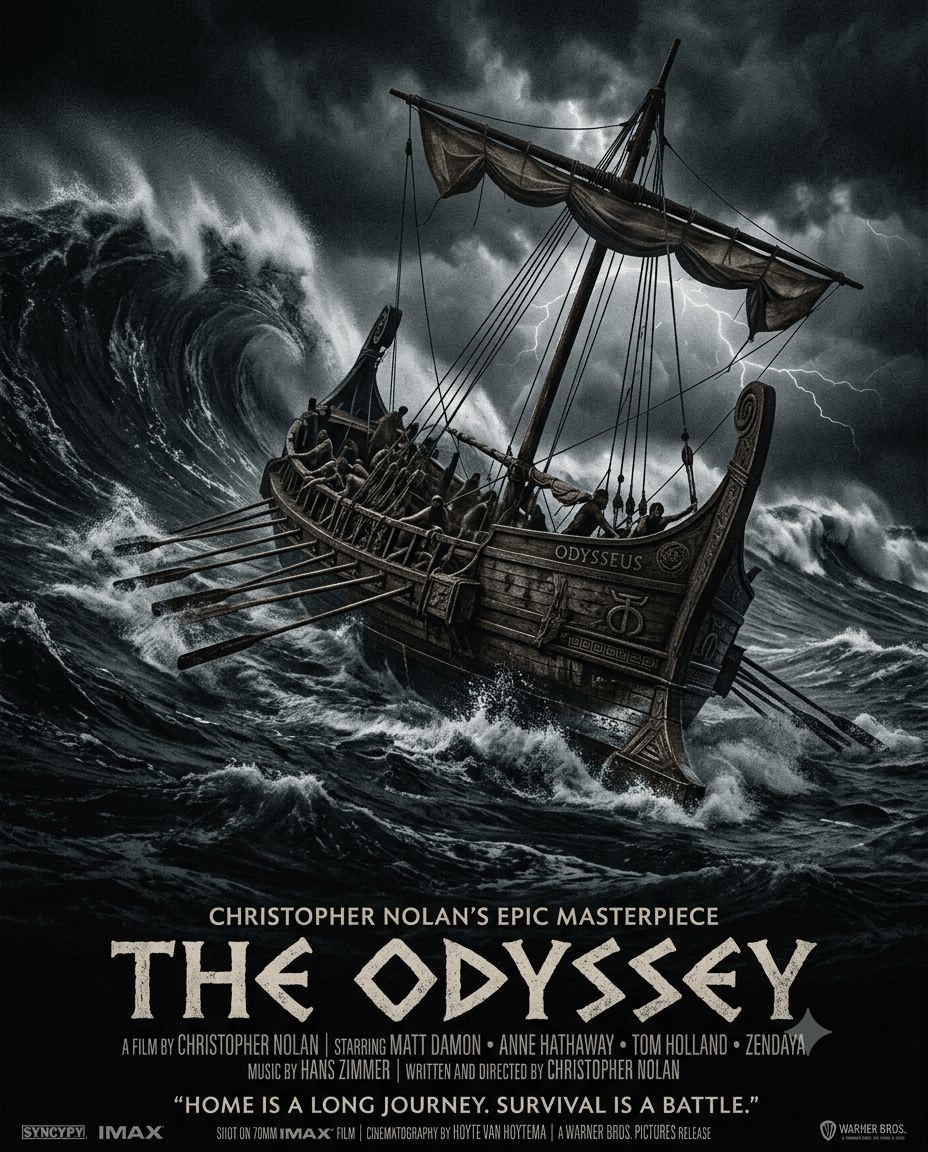
The narrative unravels across multiple temporal layers, juxtaposing Odysseus’s harrowing isolation at sea with Telemachus’s (Tom Holland) desperate search for his father, and Penelope’s (Anne Hathaway) silent, strategic resistance at home.
To understand why this film holds such staggering significance, one must look at the historical weight of Homer’s original work.
Composed around the 8th century BCE, The Odyssey is fundamentally the foundational narrative of Western literature.
It introduced timeless archetypes that continue to structure modern fiction: the flawed protagonist, the agonizing voyage home (the nostos), the monster as a metaphor for the untamed world, and the psychological burden of war.
Without The Odyssey, there would be no Dante’s Inferno, no Moby-Dick, nor modern cinematic space odysseys.
By marrying this ancient myth with the language of 21st-century cinema, Nolan achieves a profound cultural bridge.
He rescues Greek mythology from dusty academic textbooks and restores its original function: an immersive, awe-inspiring, and terrifying communal experience.
Just as ancient bards sang these verses to audiences gathered around open flames, Nolan gathers global audiences in the modern amphitheater of the dark theater, using light and sound to ignite our primal wonder.
Ultimately, Nolan’s The Odyssey is a powerful testament to the enduring power of human resilience.
It reminds us that no matter how drastically technology evolves, our core human conflicts—the longing for home, the fight against overwhelming odds, and the fragile nature of memory—remain unchanged across three thousand years.
It is an extraordinary cinematic event that demands to be witnessed, proving once again that the greatest stories ever told are the ones that bring us back to where we started.