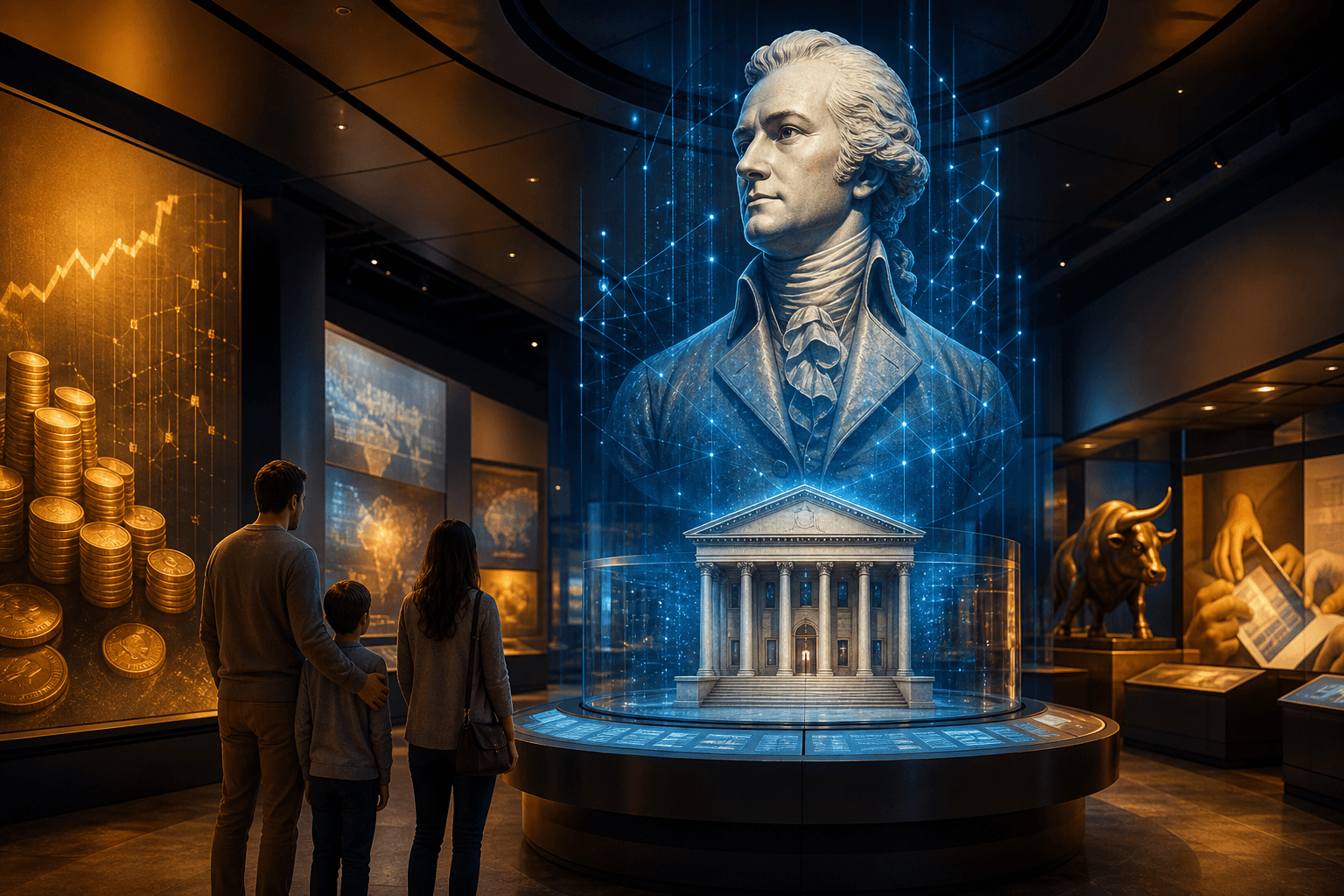
The Museum of American Finance opened its new headquarters to the public in Boston on Friday, marking the Smithsonian affiliate’s first permanent home since it left its former Wall Street location after a 2018 flood. The 5,400-square-foot site at Commonwealth Pier in the Seaport features seven inaugural exhibits focused on U.S. financial history, including an interactive artificial intelligence-generated Alexander Hamilton developed with the Fidelity Center for Applied Technology.
Museum officials and technology partners presented the Hamilton installation as a new way to expand financial education. Erich Umar of the Fidelity Center for Applied Technology said the exhibit shows how technology can broaden access by allowing visitors to interact with the first U.S. Treasury secretary in more than 50 languages and ask tailored questions, including about concepts such as compound interest. Other galleries include “America in Circulation,” which traces the evolution of U.S. currency from 17th-century pine tree shillings to modern money, and “A Financial Revolution,” which examines the foundations of the American financial system.
The museum’s reopening comes amid broader public concern about U.S. fiscal conditions. A Pew Research poll cited in the exhibit material found that 64% of Americans said in April that the federal deficit is a very big problem, up from 57% in February 2025. Federal data cited by the museum put the fiscal year-to-date national deficit above $1.2 trillion and the national debt above $39 trillion. Richard Sylla, an economics professor emeritus at NYU Stern and former museum chairman, argued that the institution offers historical perspective at a time of economic anxiety, while also contending that the country has drifted from principles established during Hamilton’s era.
Some figures involved with the museum also framed its mission as extending beyond historical preservation to practical financial literacy. Bob Pisani, a museum trustee and former CNBC senior markets correspondent, said understanding financial history can help people make decisions about budgeting, saving and investing. Rahul Arora, a financial historian and guest curator, said he hopes the currency exhibit encourages visitors to think more deeply about money as transactions become increasingly digital. Arora also suggested the U.S. may continue moving away from physical cash over time, though that remains his view rather than a stated government policy.
Admission to the museum is free, a decision its backers say is intended to make financial education broadly accessible. The opening also restores a permanent physical presence for the institution nearly a decade after it vacated 48 Wall Street in New York. With exhibits on early American finance, paper currency, personal finance and newer areas such as blockchain, crypto and tokenization, the museum is positioning itself as both a historical archive and a public education venue ahead of the country’s 250th anniversary.