SEOUL, July 28 — The global technology sector is facing a severe reality check this week. A sudden confluence of mounting skepticism over artificial intelligence financing practices and unexpected advancements in China's domestic semiconductor manufacturing has triggered a massive, synchronized sell-off across major global exchanges. The tremors, which originated in Wall Street and Amsterdam, ultimately culminated in a historic crash in the South Korean stock market, wiping out months of hard-earned gains for industry giants.
Nvidia’s 'Circular Financing' Triggers Wall Street Skepticism
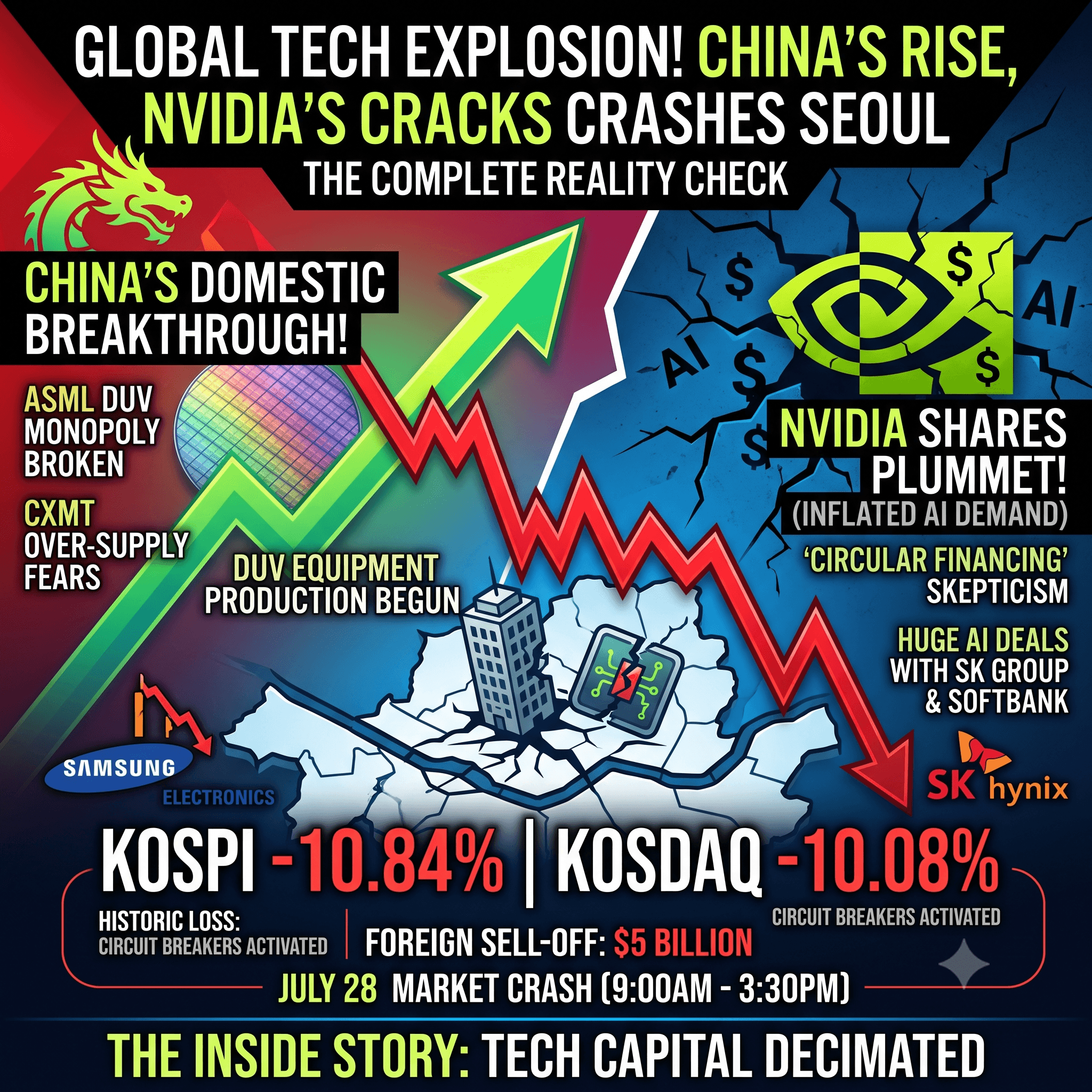
The unshakable bedrock of the recent AI rally showed significant fissures as Nvidia, the undisputed poster child of the generative AI boom, saw its shares plummet by nearly 5%. This drop effectively dethroned Nvidia from its position as the world's most valuable company by market capitalization, relinquishing the crown back to Apple. Simultaneously, the cost to hedge against an Nvidia default—measured by credit default swap (CDS) premiums—surged by a record margin, reflecting sudden and intense market anxiety.
The primary catalyst for this abrupt reversal is growing unease over Nvidia's so-called "circular financing" strategies. Reports indicate that the semiconductor behemoth is orchestrating over $750 billion in new AI-related transactions. This includes discussions to provide a staggering $250 billion guarantee for SB Energy, a SoftBank subsidiary, to secure long-term leasing for a 10-gigawatt data center in Ohio. In return, Nvidia is reportedly negotiating the purchase of $350 billion worth of its own chips to equip the very same facility.
Furthermore, Nvidia recently unveiled a colossal $500 billion partnership with South Korea’s SK Group, encompassing massive data center constructions and long-term memory chip supply agreements. Prominent investors are now raising major red flags regarding this self-sustaining loop. Renowned "Big Short" investor Michael Burry publicly criticized the structure, tweeting "Around and around we go," hinting that Nvidia funding its own clients to artificially inflate demand and valuation creates a dangerous financial merry-go-round. While some portfolio managers argue these investments solidify long-term AI infrastructure, the sheer scale of circular capital flows has left the broader market deeply unsettled.
China’s DUV Breakthrough Threatens ASML’s Monopoly
Compounding the global tech sector's woes, Europe's most valuable technology company, ASML, suffered a severe blow following reports that a state-backed Chinese enterprise has successfully commenced production of immersion deep ultraviolet (DUV) lithography equipment. Shares of the Dutch equipment manufacturer tumbled over 8%, dragging down a slew of Western semiconductor equipment peers, including Applied Materials and Lam Research.
According to industry sources, a secretive Shanghai-based startup, aggressively staffed by poaching top-tier talent from existing domestic tech firms, is targeting the production of around five DUV systems this year, scaling to twenty by next year. These critical manufacturing machines are slated for immediate delivery to major Chinese chipmakers like SMIC, Hua Hong Semiconductor, and ChangXin (长鑫) Memory Technologies (CXMT).
While ASML currently maintains a de facto monopoly on advanced lithography, and China remains barred from accessing extreme ultraviolet (EUV) tech due to US-led sanctions, this development signals that Beijing is accelerating its self-reliance goals much faster than anticipated. Although analysts caution that the Chinese systems likely lag significantly behind ASML in terms of reliability and yield—requiring substantial testing before true mass deployment—the psychological impact on investors has been profound.
South Korean Chip Giants Face Historic Plunge
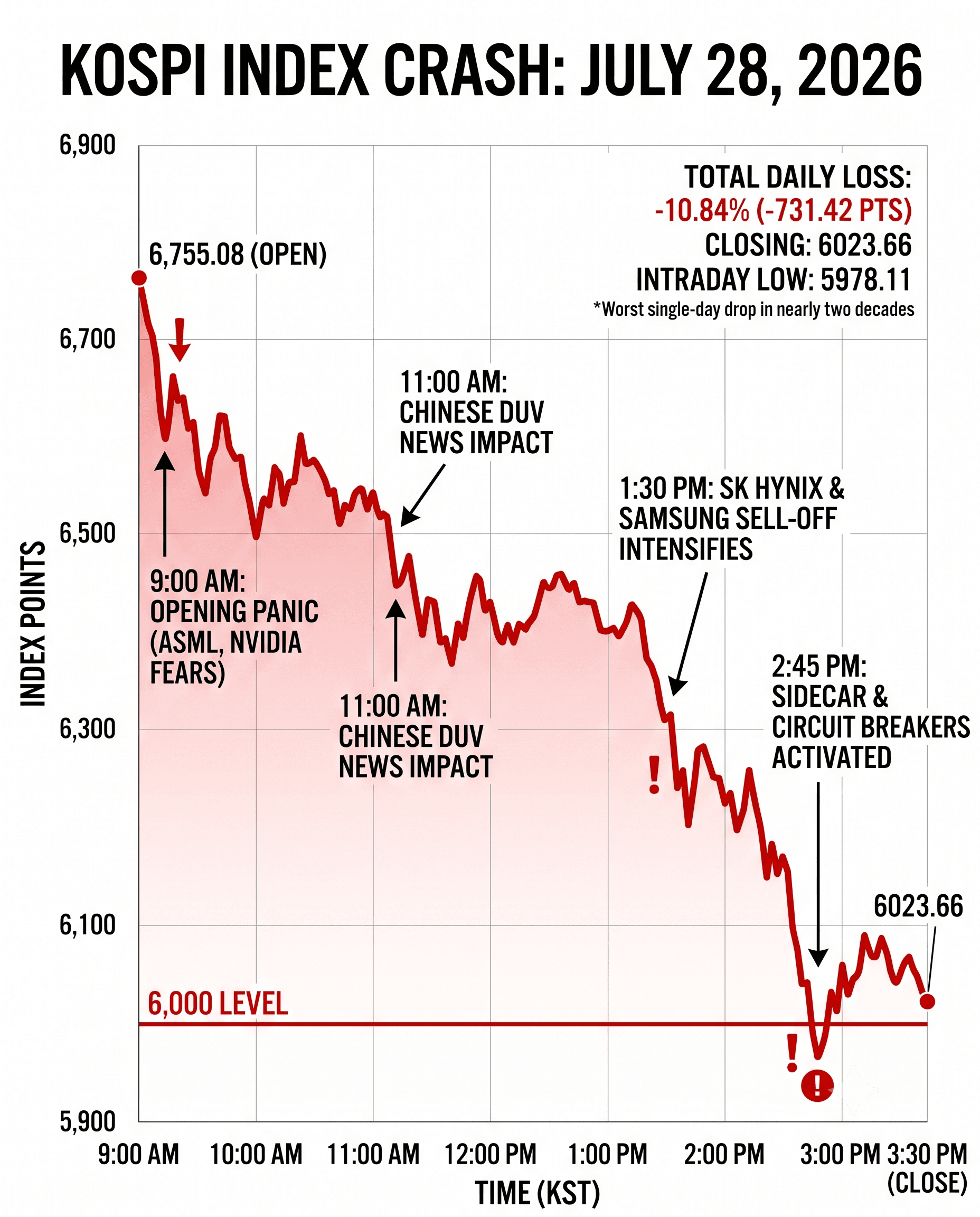
The convergence of these global anxieties culminated in an absolute bloodbath on the South Korean bourse, devastating the country's economic twin engines. On the 28th, Samsung Electronics and SK Hynix suffered catastrophic losses, plummeting by 13.39% and 14.65% respectively, effectively erasing all stock gains accumulated over the past three months in a single day.
Foreign investors spearheaded the panic selling, dumping an estimated $5 billion worth of shares between the two tech behemoths. This monumental capital exodus triggered consecutive sidecar and circuit breaker activations across both the KOSPI and KOSDAQ markets—an extreme measure halting trading to prevent a total market collapse. The benchmark KOSPI index nose-dived by a staggering 10.84%, at one point breaking below the 6,000-point threshold, marking its second-largest historical drop.
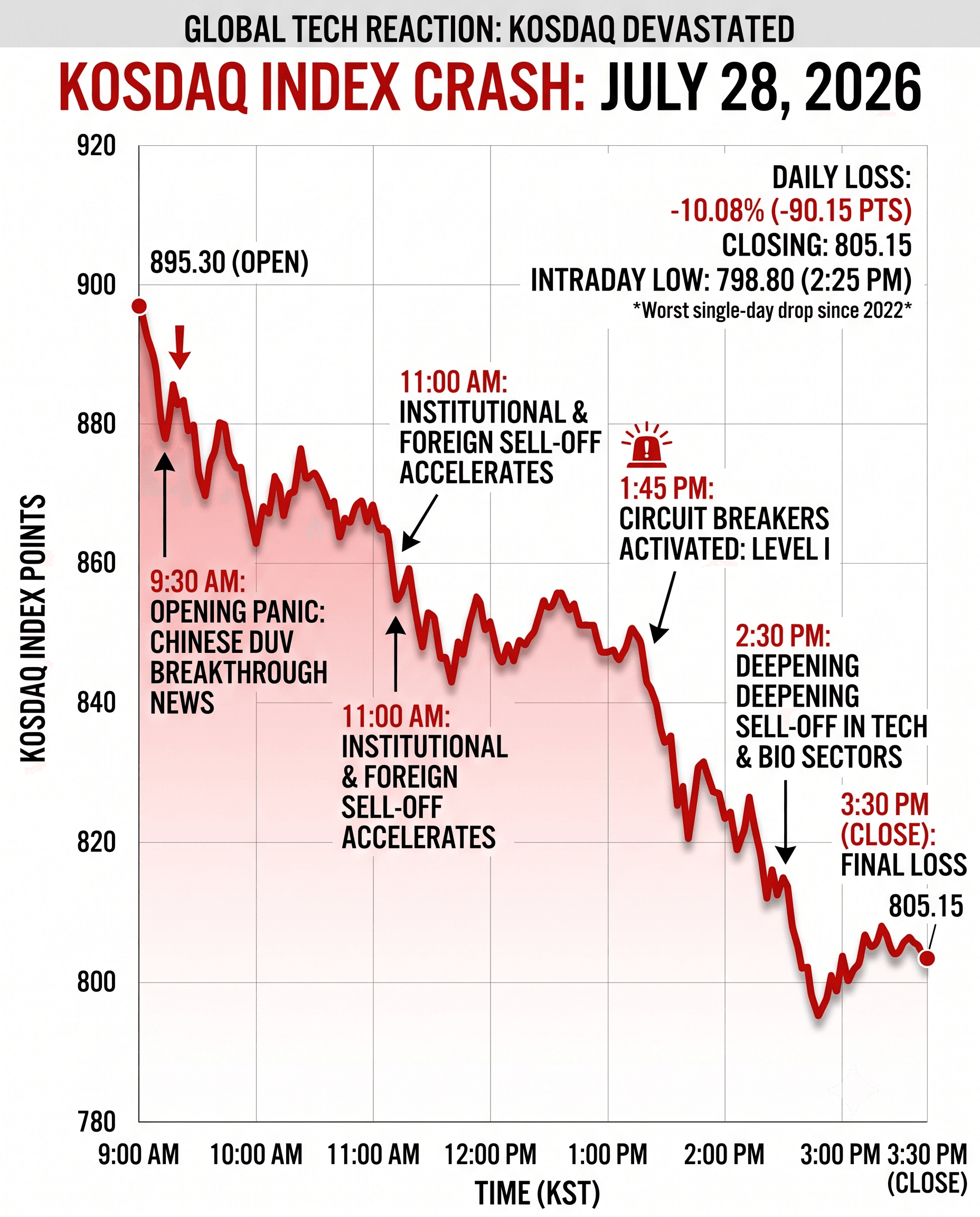
Local market distress was heavily amplified by news surrounding China’s CXMT. The Chinese DRAM manufacturer's successful and massive fundraising on the Shanghai STAR Market ignited fears of an impending oversupply of legacy memory chips. If CXMT aggressively expands its production capacity, the profitability of the foundational memory products that heavily sustain Samsung and SK Hynix could face severe downward pressure.
Despite the overwhelming market panic, domestic financial analysts are urging restraint. Market researchers at major securities firms suggest that while CXMT's capacity expansion is inevitable, its actual ability to trigger a global DRAM oversupply remains highly limited. Similarly, the immediate threat of China's nascent DUV technology to the bottom line of established market leaders is currently minimal. Nevertheless, until the dust settles on these dual geopolitical and financial uncertainties, extreme volatility is expected to reign supreme across the global semiconductor landscape.