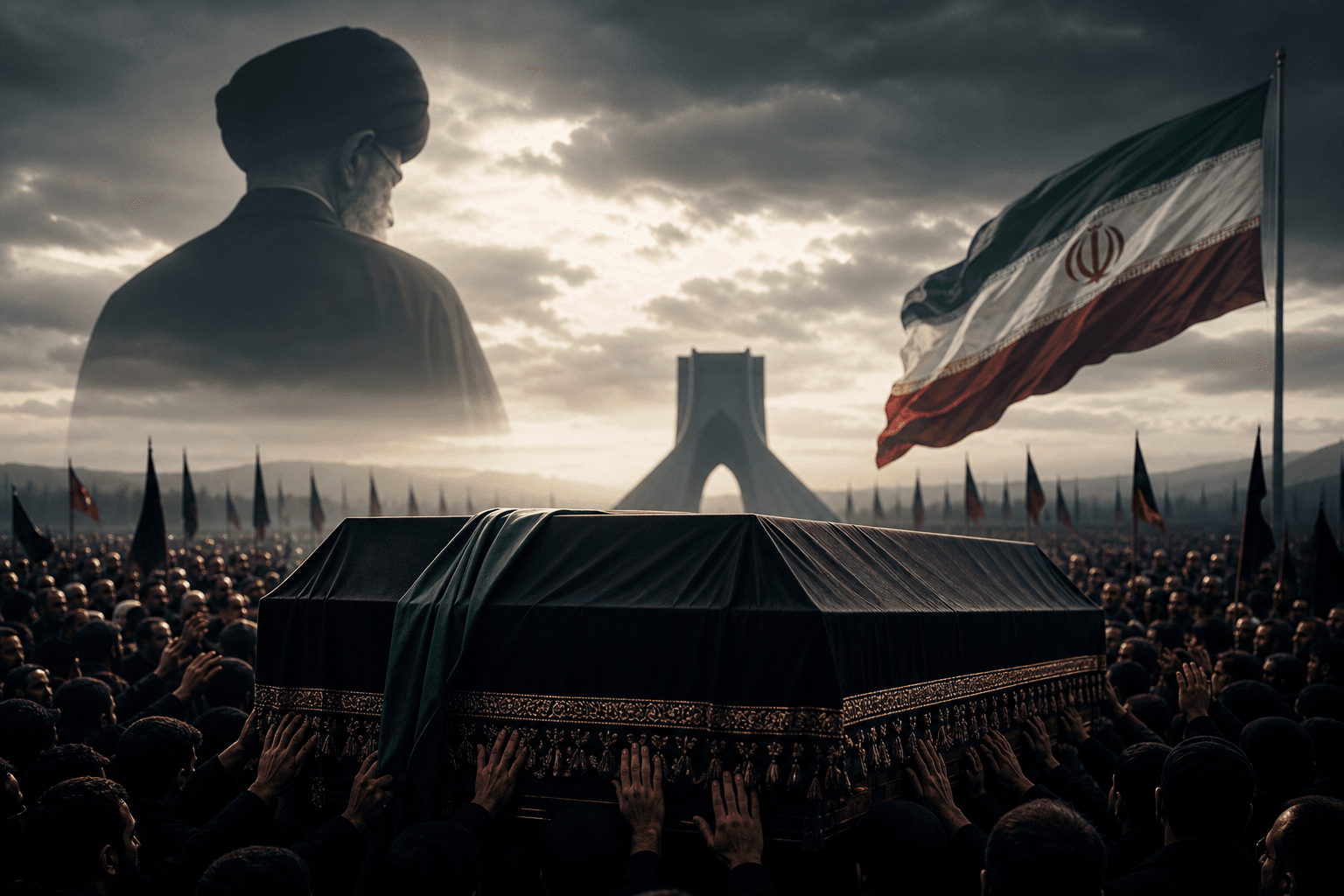
Iran began a dayslong funeral for Supreme Leader Ayatollah Ali Khamenei in Tehran on Saturday, with authorities expecting massive crowds in ceremonies that will extend to multiple Iranian cities and into Iraq. Khamenei, who led the Islamic Republic for nearly four decades, was killed in an airstrike at the start of the war involving Iran, Israel and the United States. His coffin was displayed at the Grand Mosalla religious complex alongside those of several family members killed in the same strike, including his daughter, son-in-law, wife of the new supreme leader, and a 14-month-old granddaughter.
Senior Iranian officials, military figures and foreign dignitaries were shown paying respects in Tehran. Parliament Speaker Mohammad Bagher Qalibaf, Foreign Minister Abbas Araghchi and President Masoud Pezeshkian were among the civilian leaders present, while Gen. Ahmad Vahidi, who had not been seen publicly for months, also appeared. State banners across the capital carried slogans urging the public to rise in support of the Islamic Republic, and authorities prepared extensive security measures, including street closures and restrictions affecting daily life. The funeral route is set to continue from Tehran to Qom, then to the Iraqi Shiite holy cities of Najaf and Karbala, before burial in Mashhad.
For Iran’s leadership, the funeral is not only a national mourning ceremony but also a major political display. Supporters portrayed the event as a sign of continuity and resistance, with some saying the country would maintain its defiant stance toward the United States and Israel. Iranian officials also framed the gathering as proof that the Islamic Republic remains cohesive despite battlefield losses and continuing threats. Analysts and observers, however, have cast the ceremonies as a test of the regime’s ability to demonstrate legitimacy and maintain order after a war that damaged infrastructure, weakened leadership ranks and left uncertainty about who is exercising power behind the scenes.
The transition has centered on Mojtaba Khamenei, the slain leader’s son and designated successor, who has remained largely out of public view after reportedly being wounded in the same strike that killed his father and his wife. His possible appearance at the funeral has become one of the most closely watched questions of the ceremonies, as officials, supporters and outside observers look for signs about the new leadership’s health, visibility and control. The funeral also unfolds against broader pressures facing Iran, including fragile ceasefire diplomacy, the country’s leverage over the Strait of Hormuz, and mounting economic strain after war and years of domestic unrest under Ali Khamenei’s rule.