SEOUL — If you are reading this on a smartphone or a computer monitor, chances are your eyes are working overtime right now without you even realizing it. Take a quick moment to notice how they feel. A bit dry? Slightly gritty, like someone scattered invisible sand grains across your pupils? Or perhaps carrying that dull, familiar ache behind your temples that makes you want to pinch the bridge of your nose?
Welcome to the digital stare. In an era where work, leisure, news, and even social connections happen behind glowing slabs of glass, our eyes have become the most overworked and under-appreciated organs in the human body. Evolution designed human vision for scanning wide savannahs, spotting distant predators, and tracking changing seasons under natural daylight. It certainly did not design our delicate ocular muscles to remain locked in a fixed, high-intensity gaze at a backlit rectangle thirty centimeters away for ten consecutive hours.
The good news is that saving your vision does not require throwing your devices into the nearest river. With a few doctor-approved habits and a bit of anatomical common sense, you can rescue your eyes from daily digital exhaustion.

The Golden Standard: Decoding the 20-20-20 Rule
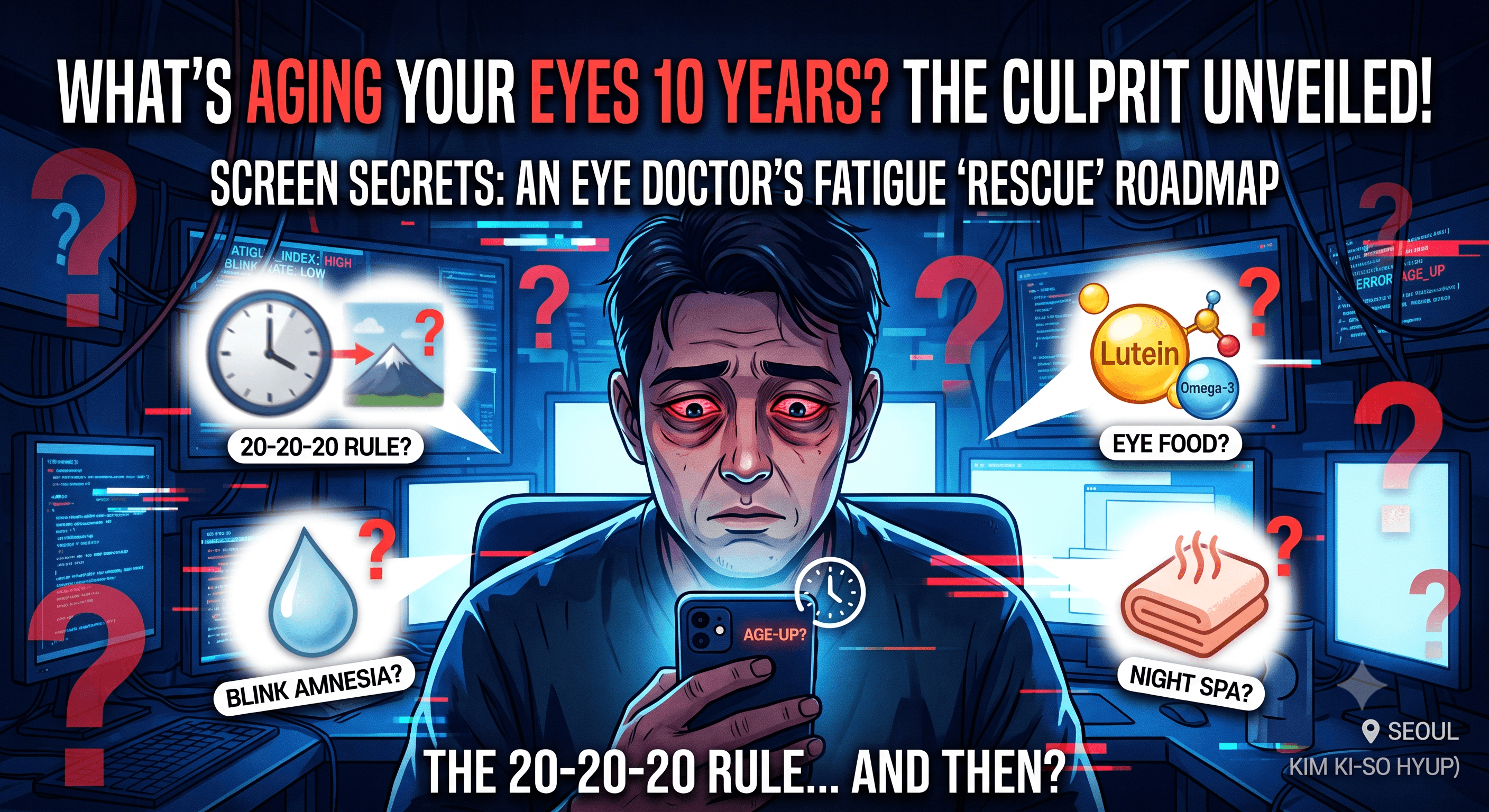
Almost every ophthalmologist will tell you that the single most effective weapon against screen fatigue is the celebrated 20-20-20 Rule.
The concept is deceptively simple: Every 20 minutes, take a 20-second break to look at an object at least 20 feet (about 6 meters) away.
Why does this specific ratio work so well? Inside your eye sits a tiny ring of smooth muscle called the ciliary muscle. When you focus on something up close, this muscle must constantly contract to thicken the lens. Imagine holding a heavy dumbbell at a half-bicep curl for eight straight hours without putting it down; your arm would scream in agony. That is precisely what your eyes endure when you binge-watch videos or scroll through endless documents.
Shifting your gaze 20 feet away forces the ciliary muscle to fully relax and return to its natural resting state. Meanwhile, giving it a full 20 seconds allows your ocular system to reset its focusing mechanism and replenish the tear film across your cornea.
The "Blink Amnesia" Epidemic
There is another insidious side effect of digital screens: they make us forget how to blink.
Under normal conditions, a person blinks roughly 15 to 20 times per minute. Each blink sweeps fresh moisture, nutrients, and antimicrobial enzymes across the surface of the eye while clearing away microscopic debris. However, studies show that when we focus intensely on high-definition screens, our blink rate plummets by more than 50%—down to a meager 5 to 7 times a minute. Worse still, many of those screen-time blinks are "incomplete," meaning the upper and lower eyelids never fully touch.
The result is rapid tear evaporation. When tears vanish faster than they can be replenished, the cornea dries out, leading to burning sensations, redness, and intermittent blurriness.
To combat this "blink amnesia," eye specialists recommend the Deliberate Blink Drill:
• Pause what you are doing once every hour.
• Close both eyes gently for two full seconds.
• Squeeze them closed firmly for another second.
• Open them and relax.
• Repeat this five times.
This deliberate squeezing action activates the meibomian glands along your eyelid margins, releasing a crucial layer of natural oil that seals in moisture and keeps your tear film from evaporating into thin air.
Ergonomics: Angle, Distance, and the 1:1 Light Balance
Fixing your posture does not just protect your spine; it directly relieves ocular strain. Many people place their monitors too high or too close, forcing their eyes wide open and exposing a massive surface area of the eyeball to dry office air and ambient heat. • Lower the Horizon: Position your screen so the top of the monitor is slightly below eye level. Looking downward at a 15-to-20-degree angle allows your upper eyelid to cover more of the ocular surface, naturally cutting down on moisture loss. • The High-Five Distance: Keep your screen at roughly an arm’s length away (50 to 70 centimeters). If you cannot read text at that distance, do not lean closer—simply increase the font size in your display settings. • Match the Luminescence: Never read from a brilliant white screen in a pitch-black room. When the contrast between your screen and your ambient environment is too harsh, your pupils are forced into an exhausting game of tug-of-war, rapidly expanding and contracting as your gaze wanders across the room. Strive for a balanced 1:1 lighting environment where your room is softly illuminated to match the brightness of your display.
Fueling the Lens: The Kitchen Eye Clinic
True ocular resilience starts from within. While carrots have historically claimed all the fame, modern nutritional science points toward far more powerful allies: 1. Lutein and Zeaxanthin: Known as natural internal sunglasses, these two carotenoids accumulate directly in the macula—the central part of your retina responsible for sharp, detailed vision. They actively absorb high-energy blue light and neutralize oxidative damage. You can find them in abundance in dark leafy greens like spinach and kale, broccoli, corn, and pasture-raised egg yolks. 2. Omega-3 Fatty Acids: DHA and EPA, found in oily fish such as salmon, mackerel, and sardines, form the structural foundation of retinal cells and directly improve the oil quality of your tear glands. 3. Antioxidants (Vitamins C and E): These protect the delicate lens proteins from cross-linking and clumping over time, which is the primary cause of cataracts and age-related clouding. Citrus fruits, bell peppers, almonds, and sunflower seeds are exceptional daily sources. The Warm Compress: A Nightly Spa for Tired Eyes Before heading to bed, treat your eyes to a five-minute warm compress. Soak a clean washcloth in comfortably warm water (or use a heated eye mask) and drape it over your closed eyelids. The heat gently melts solidified oils that clog the tiny meibomian glands, allowing fresh, lubricating lipids to flow freely across the ocular surface while you sleep. Beyond the physical relief, the soothing warmth stimulates parasympathetic relaxation, signaling to your brain that the day’s visual demands are finally over. Your eyes are not mechanical cameras that can run indefinitely without maintenance; they are living, delicate outposts of your central nervous system. Give them the brief pauses, the moisture, and the nutrients they need, and they will keep the world looking crisp, vibrant, and clear for decades to come.
TAP HERE for an English-Korean bilingual version. [영한대역으로 보려면 여기를 누르세요]