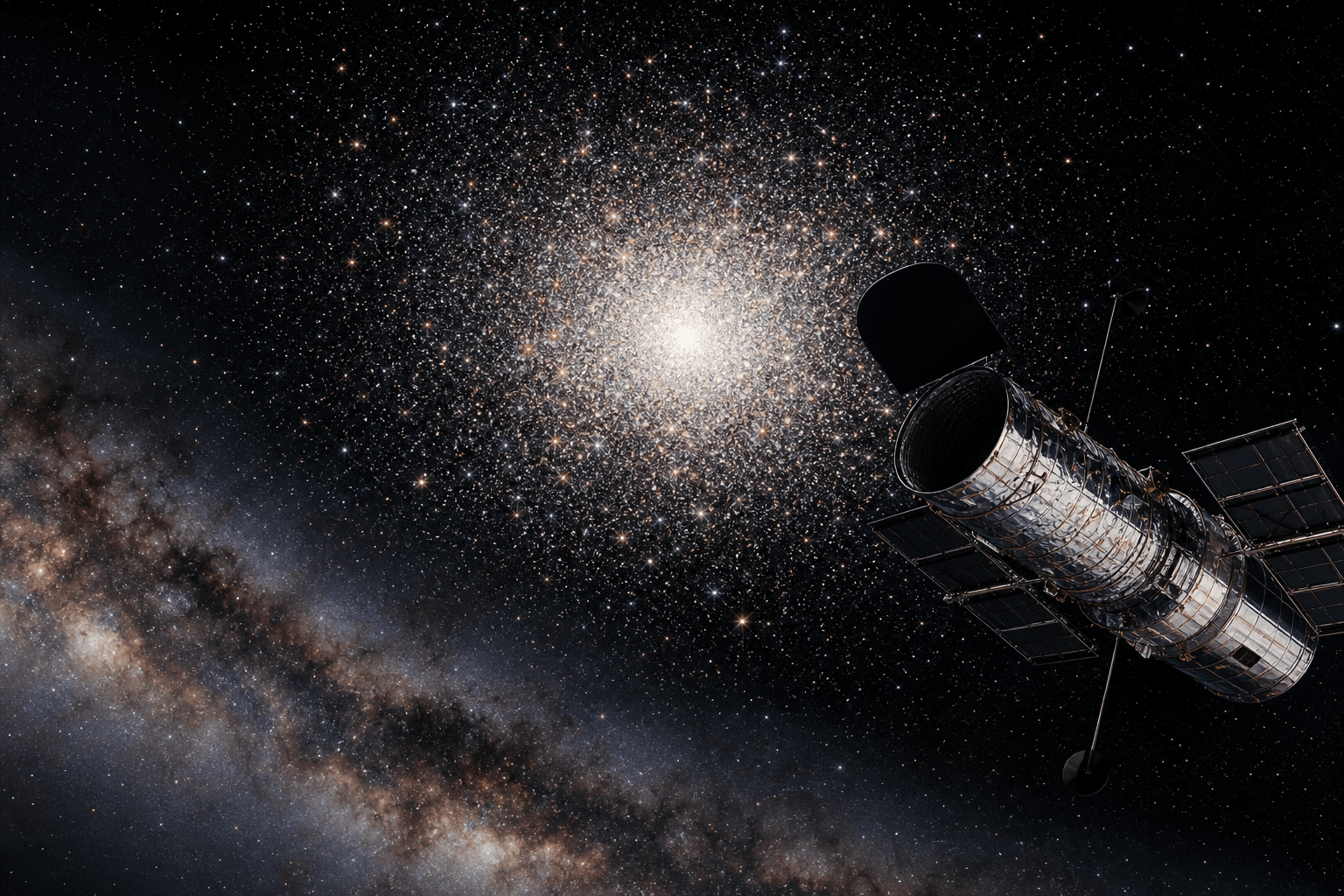
NASA has released a new image from the Hubble Space Telescope showing Messier 3, a globular cluster containing more than 500,000 stars, in a red, white and blue presentation timed to the United States’ 250th anniversary. Also known as NGC 5272, Messier 3 is one of the largest globular clusters in the Milky Way. NASA said the image is part of an ongoing effort to study ancient star systems that can preserve evidence about how the galaxy formed and evolved over billions of years.
Globular clusters are dense, roughly spherical groups of stars held together by gravity and formed from the same gas cloud at about the same time. Astronomers have identified about 150 such clusters orbiting the outskirts of the Milky Way. Messier 3 stands out for its unusually large population of RR Lyrae variable stars, with more than 240 identified there, more than in any other known globular cluster in the galaxy. Because those stars brighten and dim in a regular cycle, astronomers can use them to calculate distance by comparing their true brightness with how bright they appear from Earth.
The cluster is also known for an unusual group of around 70 candidate blue straggler stars, which appear hotter, brighter and younger than the older stars around them despite being similarly ancient. Scientists believe these stars likely gained mass through gravitational interactions with companion stars. Astronomers also suspect Messier 3 may preserve evidence of a much older merger: the presence of two distinct stellar populations has led to the view that it could have formed when two globular clusters combined inside a dwarf galaxy later absorbed by the Milky Way. That interpretation remains a scientific inference rather than a confirmed origin story.
NASA said the color processing in the image reflects wavelengths captured by Hubble’s filters, with blue corresponding to shorter visible wavelengths and red to longer visible and some near-infrared wavelengths, allowing temperature differences among stars to be visualized. The release comes as Hubble continues to operate alongside the James Webb Space Telescope and ahead of the planned Nancy Grace Roman Space Telescope. Hubble’s long record of deep-space observation has included landmark projects such as the Hubble Deep Field, which showed that apparently empty regions of sky contain vast numbers of distant galaxies, reinforcing the telescope’s role in reshaping understanding of cosmic history.