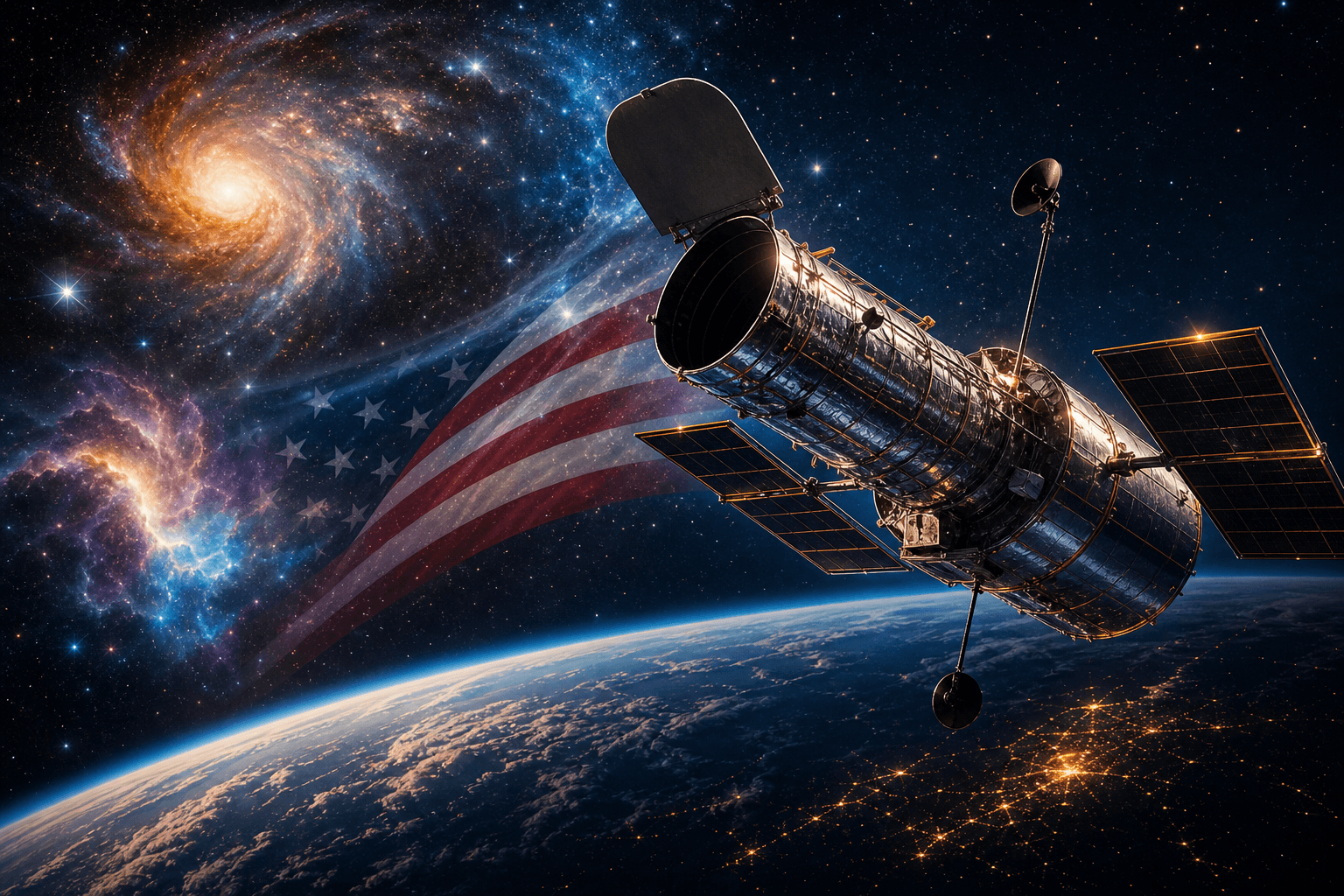
NASA is commemorating the United States’ 250th birthday from July 1 to July 4 with a Hubble Space Telescope campaign featuring newly released red, white and blue-themed space images, a retrospective of past July Fourth observations and an expanded version of its “What Did Hubble See on Your Birthday?” web feature. The agency says the celebration highlights one of its most productive scientific missions while inviting the public to engage with Hubble imagery through social media and online collections.
Among the featured elements are new Hubble images released for the Fourth of July, including views described by NASA as a crimson cloud with white and blue stars and a star-spangled cosmic scene. NASA also assembled “The Fourth of July Through Hubble’s Eyes,” a 13-image collection tied to the nation’s 13 original colonies and drawn from Hubble observations made over the telescope’s 36-year history. The birthday-themed web application now offers five different views captured on each day of the year, allowing users to look up what Hubble observed on their birth date or another occasion.
NASA is also linking the anniversary to a broader account of American space exploration. Coverage surrounding the milestone has emphasized how U.S. space science has evolved since 1776, from early skywatching to modern telescope technology and moon missions. The wider America 250 programming has included attention to Artemis II and other astronomy-related features presenting the national anniversary through a space exploration lens.
The anniversary has also drawn political scrutiny in a separate debate over how America’s 250th birthday is being organized more broadly. House Democrats on the Natural Resources Committee released a report accusing Freedom 250, a group involved in high-profile national anniversary events, of serving partisan and financial interests tied to President Donald Trump. Freedom 250 has denied the allegations, calling them false and politically motivated. Those accusations concern the wider semiquincentennial celebration apparatus, not NASA’s Hubble programming, which has centered on telescope imagery, educational outreach and the agency’s historical role in science and technology.