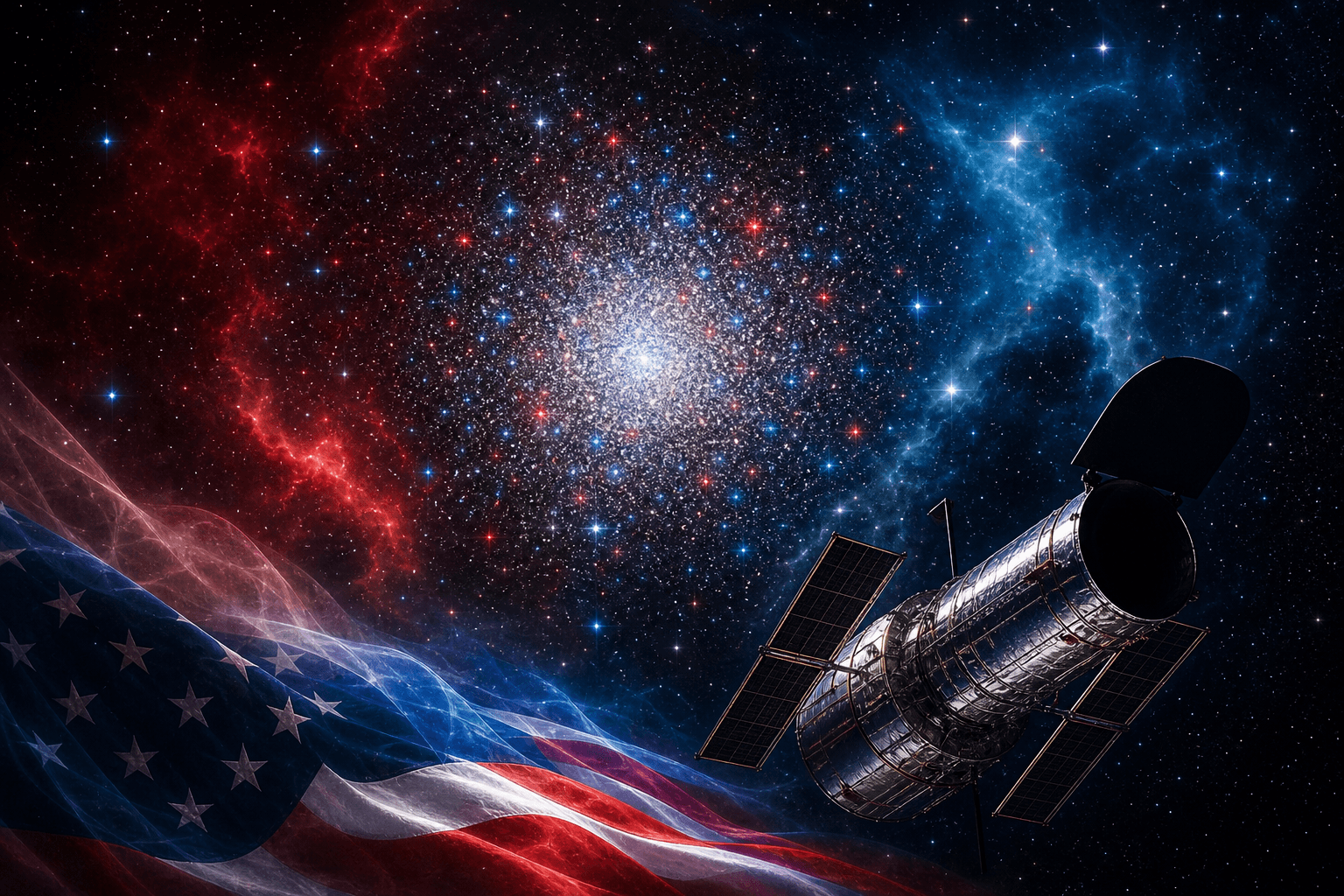
NASA has released a new image from the Hubble Space Telescope showing NGC 6426, a globular cluster in the Milky Way’s outer halo, as part of events marking the 250th anniversary of the United States. The image presents the cluster in red, white and blue tones and highlights one of the galaxy’s oldest known stellar groupings. NASA said the object is about 13 billion years old, placing its formation not long after the universe began.
Beyond its commemorative presentation, the image is part of continuing scientific work on ancient star clusters in the Milky Way. Globular clusters are dense, gravitationally bound groups of stars, and about 150 are known in the galaxy. In the Hubble image, the colors correspond to different wavelengths captured through the telescope’s filters and processed with standard techniques. Blue stars indicate hotter temperatures, while redder stars are cooler.
Astronomers study NGC 6426 because its stars have low metallicity, meaning they contain relatively small amounts of elements heavier than hydrogen and helium. That chemical composition is associated with conditions in the early universe. Scientists have also found evidence of two chemically distinct populations of stars in the cluster, a finding that suggests a later generation may have formed after earlier massive stars exploded as supernovas and spread heavier elements into surrounding gas. Researchers say that process helps explain how the universe gradually acquired the ingredients needed for planets and many of the elements seen today.
The release also underscores Hubble’s continuing role in tracing the Milky Way’s history more than three decades after the telescope began operations. By measuring the ages and chemical makeup of halo clusters such as NGC 6426, astronomers aim to better understand how the galaxy formed and evolved. Hubble’s long record of deep-space observation includes landmark projects such as the Hubble Deep Field, which showed that regions of sky once thought nearly empty contained thousands of distant galaxies. NASA says Hubble’s work is now complemented by the James Webb Space Telescope, with the Nancy Grace Roman Space Telescope expected to add further observations after its planned late-summer launch.