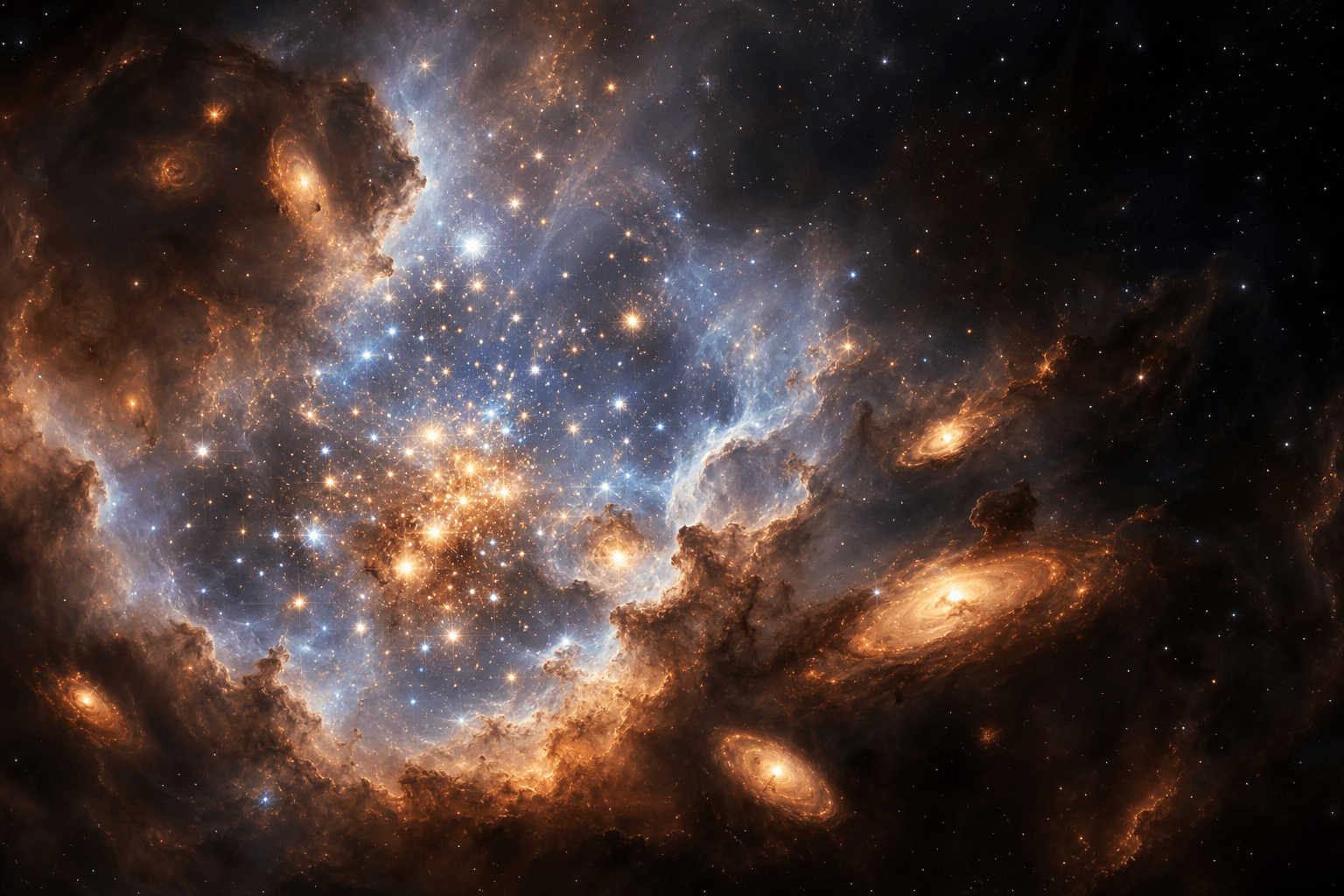
NASA has released a new Hubble Space Telescope image of LH 95, a star-forming region in the Large Magellanic Cloud, highlighting what astronomers describe as a densely populated stellar nursery where about 2,500 young stars are still developing. The observations focus on pre-main-sequence stars, objects that have gathered most of their mass but have not yet begun hydrogen fusion. Researchers said the data indicate these stars can continue drawing in gas and dust for several million years, extending a phase of stellar development that some earlier assumptions had suggested might be shorter.
The image shows blue and white stars set against crimson hydrogen gas, with the red glow linked to hydrogen-alpha emissions that signal active star formation. NASA said the brightest blue stars in LH 95 are also reshaping the region through intense ultraviolet radiation and stellar winds, which heat surrounding gas and help carve the nebula's structure. Dense dust lanes remain visible as darker filaments because they are more resistant to erosion by those energetic forces.
Astronomers also said LH 95 appears to contain multiple generations of stars rather than a single burst of formation. One especially massive star in the region is estimated at roughly 60 to 70 times the Sun's mass and appears to be about one million years younger than most nearby stars, which are put at around 4 million years old. Scientists view that mix of ages as a useful window into how star formation can unfold over extended periods within the same cosmic environment.
NASA described LH 95 as especially valuable because it is relatively nearby and less obscured by dust than similar star-forming regions within the Milky Way, allowing a clearer look at stars in different stages of growth. The findings add to Hubble's long record of deep-space observations, from studies of stellar nurseries to earlier landmark projects such as the Hubble Deep Field, which demonstrated the telescope's ability to reveal previously unseen structure in apparently dark regions of space. Hubble's work is now complemented by the James Webb Space Telescope, while the Nancy Grace Roman Space Telescope is expected to further expand observations of the universe.